
|

|

|

|

|
The Miracle of Nature
John Haberin New York City
Giovanni Bellini's Saint Francis
This is about a rendezvous with the sun. It has just risen, but already the sky is bright and the earth is full of color. Its sphere cannot be seen, but its yellow touches every corner of the landscape, warming the distant city like a blanket. It swirls into the leaves, flashing on the face of rocks, delineating every crevice.
It overflows those corners, expanding the roughly four-foot-tall, near square of canvas into something spacious and familiar as the world. Its radiance is measured with unnerving precision, as if with a light meter. It demands a response just that fresh, open, and exacting—from the man standing at the painting's heart, from the believer, from the museum-goer today, from anyone. 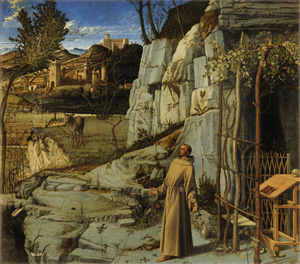
The man is easily recognized as Saint Francis from his light brown cassock and tonsure, or shaved head. Any Renaissance Venetian would also quickly notice the stigmata, or wounds of the crucified Christ on his hands. The painting, completed by Giovanni Bellini around 1478 and now in the Frick Collection, clearly shows the popular saint's traditional features, intensely focused expression, and rural cell furnished sparingly with a skull. Bellini added the skull only as he worked, along with the small ledge on which it rests, extending the saint's lectern. He began with nothing that one could not find in nature. Even the light began with the clear blue of the distant sky.
One knows all that from another kind of miracle. Conservators at the Met have cleaned the painting and subjected it to a thorough technical analysis. They have used infrared reflectography and x-rays to study the surface and the fine drawing in ink beneath, mostly to confirm what they already knew. An expert at the Cloisters has identified the wealth of flora, like an entire medieval garden. For just a few months, the Frick has taken Saint Francis from its home above a mantel, where it has rested as long as anyone can say. One can examine it for oneself in the Oval Room, and videos of the restoration online are worth every moment of study, too.
A miracle
Giovanni Bellini, who died in 1516, was just past the middle of his long career. (The Frick dates the work several years earlier than a previous generation of scholars.) His father, Jacopo Bellini, founded a great line of Renaissance painting; and his brother Gentile explored the decorative potential of oil at the Ottoman court, as the official representative of the doges of Venice. Giovanni has somehow encompassed both the ecstasy that was held to accompany the stigmata and the solitude and community with nature of a life spent in contemplation. The first miracle was said to have been given to only the holiest of men. The other, Bellini plainly insists, has been the gift of even fewer.
To ask how Bellini could combine the richness and austerity of the saint's legend is to look for the subject of the painting, and art historians cannot agree on one. Conventionally, Francis is shown in meditation or else receiving his miraculous markings. In the first case he sits alone in his cell. In the latter story he kneels, while rays from an angelic source pierce his hands and chest and a brother Franciscan bears stunned witness. Bellini's Saint Francis has abandoned his quiet cell to stand alone, his chest unbared. The only radiance is of that glorious sun.
A few art historians have tried to fit the painting's features more exactly, a discipline of art history traditionally called iconography. And they found in the twelfth-century saint, the icon of a new humanism, a good source for folk tales. Francis, after all, combined life among ordinary people with the appeal for the elite of austerity and intellect. He wrote hymns, so one story goes, and his wide-open mouth may mean that he is in the midst of one. Restoration confirms that the painting never held an angel. It has lost at most a few centimeters at top of tree, sky, and cliffs—and nothing of its radiance.
More ingenious still, Millard Meiss has found another miracle. In a fitting response to Francis's ecologically aware piety, the sun is alleged once to have shined at night. Perhaps the herdsman far in the background indicates how people and even animals were fooled into beginning their daily rounds. So perhaps was the entire cycle of nature, right down to flowers that open at dawn. Bellini captures them with just a few dry strokes of white across a crevice in the rock. The painting's traditional title, Saint Francis in the Desert, cannot do justice to the fertile hills of northern Italy.
This is the wrong time and place, though, to look for hidden doctrine. Like Francis's life, the painting wishes to be plain as day. In postcard reproductions, its careful outline drawing can suggest the dense symbolism typical of the Northern Renaissance. Even in person, detail emerges the longer I look. A rabbit peeps out from between rocks like a refugee from Where's Waldo, while the artist's signature, on convincingly creased and rumpled paper, hangs not far in front of a drain spout. Water sparkles down, as the only motion amid the stillness.
Still, Bellini's lighting integrates and softens rather than differentiates details. It lets in air and reverence rather than isolates a refuge for fine points of doctrine. Nothing seems out of place, least of all that gorgeous sunlight. With its touches of yellow, it seems to have carved out the blue-green rock. It elevates the distant fortress into both an unseen humanity and a heavenly city. By painting on a ground of lead white mixed with oil, on which an assistant's palm prints can still be seen, the artist achieves that sense of light entirely from within.
Putting the books aside
Besides, hidden meanings are at least as hard to support from the literal evidence as any traditional ones. In a Renaissance picture about music, the singer invariably holds a prop. The painting has signs everywhere, but not a guitar. Anyhow, in the unlikely event that a painter of the day could express such nuances with only a gaping stare, Francis looks to me more amazed than lyrical. Then, too, whatever the saint is doing, I can almost hear the silence. Moreover, if the sky deviates from natural sunlight, I am fooled quite as much as the cattle.
Any interpretation should drive back to the painting's center, Francis's ecstatic reception of the day. Song would be only a sign of that elation, strong daylight its awakener. Because the folk tales take both sun and music as manifestations of God and nature, they naturalize the subjects of older paintings—the saint's meditations and the miracle of his taking on the marks of God. Cleaning reveals that the stigmata are original, including a tiny incision on his foot that has lost its pigment. Up close, the red on his hands separates into paint crystals like fresh bloodstains. I am insisting, in other words, not on hidden, more literal evocations of stranger themes, but on a naturalized representation of familiar ones.
I accept Saint Francis's gesture as the conventional representation of his stigmatization, but unconventionally stripped of its symbolic context. It anticipates the patient waiting of Vermeer's women, shorn of their stories but full of longing. What then does he cover with his outstretched, wounded palms? The tokens of life's daily rhythms. If those rhythms seem miraculous, not even a painting can dissolve the tension between the natural and the human. That tension is the painting's ultimate subject, just as the rocks seem sculpted and the town a part of heaven.
Putting the books aside to talk in simpler terms would not have made sense in a painting of barely a decade earlier. Before Bellini, humanism had hardly penetrated Venice. Earlier Florentine artists named Veneziano had left their city of origin for a more "advanced" location. Now a painter could dispense entirely with obvious subject matter and make a person the object of attention. He has left his sandals behind, in his shadow, because his own steps create holy ground. From here on, the barest of human gestures can tell a story, because one can no longer dismiss the chance that they are all there is.
Before Bellini, too, sunlight could not have been a principal in a religious drama. Andrea Mantegna before him was a pioneering draftsman and humanist, but Bellini's mastery of oils has obliterated his older cousin's dry contours. Supple greens, browns, and yellows intermingle in leaves of the laurel tree; the artist overpainted on his still-wet medium. Thin glazes of oil paint, influenced by Antonello da Messina, underscore the crisp rock face. It is impossible to say whether formal and technical innovations have driven content or the other way around. Bellini inherits his craft, sees its potential, and annihilates its limits.
Up close now, the painting looks larger, and Francis is at eye level. He avoids one's gaze by turning toward the light, but the skull does make eye contact. The saint's face builds on its bone structure, too. Here in the Oval Room, Bellini no longer keeps company with his pupil, Titian, but instead with aristocratic full-length portraits from a later era. Not that Bellini did not contribute to the Renaissance portrait, but better tune out the comic contrast, though, much as the saint refuses to dress up. I cannot swear that the colors are brighter now, because I remember them as so brilliant and warm in the first place.
Bowing to nature
The composition starts with a diagonal. In two dimensions, a saint responds to the miracle at upper left, with the patient donkey along the way. In three dimensions, a real landscape sweeps into depth. The sun lies just beyond the frame, the light resides in the oils of the canvas, the canvas rises to the horizon, and the landscape is identical to the picture plane. Bellini's innovations take the naturalism of these features as one pole, the figure as another. Put differently, a painting's boundaries and the Renaissance's remarkable means of representation may be opposed to the subject at its center.
Look at how they play off each other. The laurel bends toward the saint, while the rock face curves behind to embrace him. Together, their monumental arch anticipates the High Renaissance pyramid. Vines twist to outline his cell, just as the rope twists around his waist—incised in oil, probably with the tail end of a brush. The velvety sunlight etches a day's growth of beard or the fur inside the rabbit's ears. Nothing here is clearly natural, supernatural, or artificial.
A viewer's eyes can follow as one line of indentation in stone is adapted to a man-made seat. The irregular crevice gives way to drainage, intruding on nature and returning to it; but no demarcation point can be found along the way. It is unclear where nature or civilization leaves off. This is neither the city depicted at top left, nor a self-contained landscape like the sheer rock at the upper right, but an altogether different world. In a sense, Meiss is right after all, for the painting sums up a lifetime—just as Leonardo's Last Supper, Leo Steinberg has argued, holds both a single, shattering moment and eternity. The saint could be in song after all, or he could be taking in the Holy Spirit and feeling it on his tongue.
Just as the sun and the tree bow to meet Saint Francis, he has turned to meet them. He leaves behind the cave, with its darkness and dry skull. His face shows excitement or shock, but his open arms indicate a welcoming acceptance. He gestures with one hand toward the peeping rabbit, with the other to a water jug. In different ways, he is reaching out to springs of life, indifferent to what is natural or his own—just as oil painting uses new means to unite the viewer with the seen. The painting's unity of nature and humanity, like the individual taking on the emblems of crucifixion, emulates a god's assumption of human death and promised gift of life.
Art and nature are the only holy witnesses. The sun is the only carrier of the stigmata, in yellow-gold impasto added later to white clouds. In this reinterpretation of a miracle, a saint has turned away from solitude and death to embrace life. In the process he finds the marks of death on his physical body, but underneath each mark lie new signs of life. Francis serves as a reminder that the most meditative art gains its strength from the narratives it invokes and refuses. Like Bellini as well, it breaks the boundaries between artifice and nature.
To work in oil, to live by studying the world, and to face the meaning of old texts are the Renaissance painter's way of facing the same paradox as Francis. The more Bellini copies the appearance of things, the greater the artifice, and the harder it is to tell whether the artifice is more richly highlighted or better hidden. Starting with the Renaissance, it becomes harder to know when art enriches old meanings or disregards them—when its formalism is the bearer of significance or is instead the whole point. Much of art ever since makes sense as a kind of productive refusal, just as Edouard Manet responded to the official Salon and the Louvre by playing off another work now in the Frick. Like Francis's monasticism, but sometimes a lot sexier, not even abstraction is just a refusal of the world. As it makes sense of the rising of the sun, this art puzzles out the fragility of self-understanding and delight.

Bellini's "Saint Francis in the Desert" is in The Frick Collection, where the display of its restoration ran through August 28, 2011. I wrote the heart of this essay fifteen years before. The work has since been the sole painting to have a room to itself in the Frick Madison and has hung with an equally elusive painting by Giorgione.