|
|
|

|
|
The Collector
John Haberin New York City
Barbara Bloom
Barbara Bloom could find her way into practically any museum, whether of art, design, science, or antiquities. She takes the museum as her subject, and she ever so quietly makes it over in her own image.
Five years after a retrospective, she does so again at the Jewish Museum. For "As It Were . . . So to Speak," Bloom embeds timepieces in facing white sofas and what might pass for their pendulums in a simulated white piano. And yet in her museum, time never stands still. 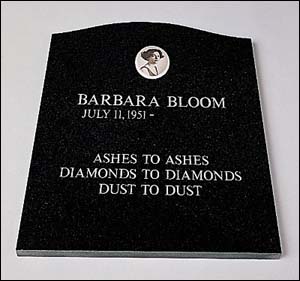
The muse of the museum
Bloom hit her stride in the late 1980s, when everyone was talking about appropriation, but artists were acting like stars. Rather than an appropriator, however, one might better describe her as a collector, with a virtual cabinet of wonders. She calls her retrospective "The Collections of Barbara Bloom," and it could well have drawn on any number of museum collections. She finds use for everything from ancient statuary, eighteenth-century furniture, and European paintings to travel posters, Playboy, and an engraving on a grain of rice. She cherishes things, even at times in reproduction. She also cherishes their absence.
She may borrow, photograph, or recreate them, and she often makes it hard to know the difference. Her 2007 gallery show, subtitled "Absence-Presence," greeted one with shadows—of a music stand, a bentwood hatrack, an easel. At least it seemed so, for she had painted the illusion on the wall. The commodities themselves lay further inside. So naturally did their shadows, exactly as one had seen them before. Then came one's thoughts of them, of their history, and of the gallery's West Village townhouse, where those signs of good old-fashioned culture looked so at home.
Bloom has adapted to museum spaces, too. Her best-known installation, The Reign of Narcissism, expanded to the scale of a period room. It also introduced her face onto each Regency piece. Her curly hair and high cheekbones seemed meant for another, finer era. And in fact they appeared in black and white, like a vintage photograph for Luigi Ghirri or a silhouette. One could forget for a moment that the work had opened in 1989 at the Museum of Contemporary Art in Los Angeles and then in Soho.
Of course, her work belonged to her time, too—when the "me generation" had grown up and irony ruled. The obsession with her own image fit just fine with that of Cindy Sherman. Claiming well-known art for herself fit with Sherrie Levine, and her grainy photographs and men's magazines fit with Richard Prince. The Reign of Narcissus turned up again ten years later, in "The Museum as Muse," like a period room for the "Pictures generation." MoMA could have titled the group show just for her, her inspiration, and her desires. She had become the muse of the museum as muse.
For all that, Bloom has a welcome directness and a lack of disdain. Unlike Sherman, she makes no effort at disguise. Unlike Levine, she respects this stuff and accords it a past apart from her. Unlike Prince, she looks beyond his corner of contemporary America, and she places some serious limits on the male gaze. I could not quite make out the pornographic image on a grain of rice, even with the magnifying glass that she graciously supplies, and I definitely could not drool over it. For her Playboy issue, she manages to find a copy translated into Braille.
If she laughs at anyone or any institution, it is herself. In her hands, black granite looks ever so elegant, even if it supplies her tombstone. It also necessarily gives a woman's age, along with the inscription "Ashes to Ashes / Diamonds to Diamonds / Dust to Dust." It does not even add a lecture on conflict-free diamonds. It cannot give the date of death of her death, but maybe she can add one later. Or maybe a future museum can.
No ideas but in things
Work like this is sensual and philosophical rather than overtly political. Talk of her "collections" echoes the vocabulary of the fashion industry, but also the multiplicity of her or a museum's perspectives. If Braille seems to lose the point, unless you really and truly buy Playboy for the interviews, that approach to reading invokes the sense of touch. The foldout takes on a new light. Other works hang behind gauze curtains, which lend them a filmy white and invite others to touch as well, to lift the veil. I instinctively looked behind me for fear of the museum guard, even after it sank in that Bloom places the wall labels behind the curtains as well.
Her work makes an intriguing contrast with another retrospective not so very long ago, that of Lawrence Weiner. He says that his conceptual art need not be made, but it hits one like a shotgun blast, and it keeps its messages short. Her work has to exist, but with a studied reserve befitting its beauty. Regrettably, the International Center of Photography heightens Bloom's reserve, with little hint that the viewer has or could enter the work. Where before she adapted to a posh gallery and to a period room, here she adapts as best she can to a depressingly clinical midtown lobby.
She plays enough mind games for a whole show of conceptual art, but it becomes material. Like Williams Carlos Williams, she knows "no ideas but in things"—but also no things without a history of ideas. Big color swatches on the entrance wall form neat squares, as in a designer's Pantone flip book or "Color Chart" at MoMA, but the labels do not match the colors. For that matter, unlike Jasper Johns, she does not give the words for colors, just a jumble of names and terms. As in a video by Gary Hill or William Wegman, a child or a dog could be learning to read, stumbling every step of the way. The photos behind the curtains run from Neoclassical nudes (which might seem to need a decent covering) to more curtains, more paintings nestled behind more curtains, and people milling about looking at paintings and curtains.
"The Collections of Barbara Bloom" insists on art in the plural. It also goes by theme rather than chronology. Its rooms focus on such weighty ideas as "Stand-ins," "Twins," and "Doubles"—daring one to figure out the difference, if any. Wall labels mix ordinary museum assistance with someone's meditations and qualifications. They refer to the artist as yet another fiction, a character known only as BB. One wall label appears twice.
That label evinces BB's measured distrust of beauty, along with her respect for it. She gives a classical definition of beauty, as the proper relationship of parts to the whole. Then a series of questions demands what one could ever mean by the whole. Like Jacques Derrida discussing the frame of a painting or Constantin Brancusi making pedestals into art, she asks how a work can ever be said to begin or to end. Perhaps behind the curtains. A photograph of a chicken posed before two corner mirrors makes me think of Oscar Wilde's disdain of realism—as "the rage of Caliban on seeing his reflection in the glass."
Bloom returns often to Vladimir Nabakov. He, too, was a collector (of butterflies), an esthete, a comic pornographer, a modernist, and a creator of postmodern metafiction all at the same time. Nabakov might have succumbed to the stultifying detachment of the ICP, and Bloom very nearly does now. Still, the show offers a good prep course for Bloom's amazing shadow boxing. One work makes Volume One of the first edition of Lolita into a drab green rug. Next time, she can defer the novel's conclusion, past Volume Two.
Speak, memory
Furniture shares the center of a room at the Jewish Museum, but one can hardly call it freestanding, not when it serves as display cases for the permanent collection. "As It Were . . . So to Speak" tempts one to luxuriate in the old Warburg mansion as in one's living room, but one cannot sit or play. It invites one to "eavesdrop on a conversation," whether between Felix and Frieda Warburg or between Arnold Schoenberg and George Gershwin—the unlikely friends and Hollywood tennis partners whose scores lie open, side by side, on the piano. But one cannot overhear their voices or the music, and one had better check one's watch for the time. The piano strings have scolding index fingers because they are not pendulums, but Torah pointers. Eyes, in facing walls in each of the installation's four rooms, may well belong to the Warburgs, and they could be looking at each other or at you.
I could understand if you were tired of wall text. It has reached the point that museum crowds may spend more time reading than looking at pictures—unless, that is, they are taking photos with their cell phones. Bloom's conversations, though, depend on it. On the opening wall alone, a curator's description wraps around smaller type three times over for the artist's voice. Did you note that the layout imitates the Talmud? Within, the text continues on paper set beside each display, appropriately enough on facing pages.
Those pages hold mostly quotes, although one cannot always say for sure. The text accompanying playing cards and a "Dreyfus Affair game board" imagines a dialogue among Emile Zola, Amy Winehouse, Nefertiti, and Jesus. A display of amulets leads to Joan Didion on "magical thinking," and spice containers lead to meditations on each of the five senses, like a hidden history of the arts as synesthesia. They range from Pythagoras to Tilda Swinton, with stops for Wassily Kandinsky, Duke Ellington, and Marilyn Monroe along the way. The timepieces lead to the slippery nature of past and present, in quotes from Albert Einstein and Marcel Proust. As Claude Lanzmann is heard to say about Shoah and the Holocaust, "We speak for the dead."
Who, though, is really speaking, and who can speak for the past? The question has haunted Bloom since her first imaginary museum, The Reign of Narcissism in 1989. Yet she was not just deriding dead white males or taking their work as her own, no more than Marcel Broodthaers with his artist's museum. Since then, she has evoked their ghosts in a gallery's townhouse, with silhouettes like those of the spice containers behind glass at the Jewish Museum. Like Fred Wilson at the Studio Museum now, she has worked more than once now with an actual collection—including "The Collections of Barbara Bloom," at the International Center of Photography in 2008. Somehow, the more she enters the museum, the more its images and objects give way to books within books.
The exhibition's title, taken literally, pinpoints the commitment of a museum to the past, "as it were," and to its voices, "so to speak." And of course each idiom puts them all, so to speak, in quotes. The show's subtitle calls this "A Museum Collection in Dialogue with Barbara Bloom," but the art's voices clearly run to others, like me and you. In the mansion's former dining room, where Aby Warburg may have pondered his famous library, under the original chandelier, glassware borrows from the cafeteria downstairs along with Kiddush cups. That does not make for a virtual museum, although the Jewish Museum takes the occasion to launch 010011.net with Chris Mann as an "anti-Google"—laid out like a collaboration between a search engine and the Talmud. Still, it says something that the one repeated text, from Matteo Ricci (a Jesuit scholar) in the sixteenth century, speaks of "building a memory palace."
The dialogue definitely takes in the curator, Susan L. Braunstein, and a designer, Ken Saylor of the firm Saylor & Sirola. Objects here serve less as symbols or treasures than what Bloom calls ambassadors or intermediaries. They run to glasses that might touch, as in a toast or a poisoning, and to the tokens exchanged among Sigmund Freud's inner circle, as in a secret society. Here text can be controlling, like marriage and divorce contracts in a bed-shaped display case, or controlled, like the words of Friedrich Nietzsche in the hands of his sister, a Nazi sympathizer. It comes closest to a conversation, though, when it threatens most to slip away. The show ends with two dissections of charity, from Moses Maimonides and the IRS, and I wanted to read them both not as rules and regulations, but as pleas for giving, for taking, and for hope.
"The Collections of Barbara Bloom" ran at the International Center of Photography through May 4, 2008, her "Takes One to Know One: Absence-Presence" at Tracy Williams, Ltd., through June 22, 2007, and "As It Were . . . So to Speak" at the Jewish Museum through August 4, 2013. There she quotes Einstein as saying that, if you cannot explain something to a six-year-old, you do not understand it. I doubt that I could explain her to a six-year-old or even to myself, but I can always keep trying.