
|

|

|

|

|
Private Languages and Mass Hysteria
John Haberin New York City
Catherine Sullivan, Anna Craycroft, and Michael Portnoy
Art has a broader public than ever. People wait on long lines at museums. Tour groups march through Chelsea galleries. Prices soar.
Yet most people still find modern art difficult, older art obscure, and contemporary art a fraud. The accusation sometimes comes as a left-handed compliment: art means whatever artists want it to mean. But can artists ever speak only to themselves? 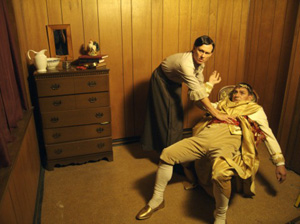
Maybe not, but they can have a slippery narrative, elusive political undercurrents, overlapping voices, and a few jokes here and there to boot. One might be entering a conversation in the middle between some very fast talkers. The language of art may seem to have broken down—or to speak more loudly and more personally than ever. If that sounds hysterical, Catherine Sullivan treats video as studies in hysteria. Anna Craycroft has her very own syndrome, with a textbook description to match. Michael Portnoy gets dizzy, too, thanks to a certain gambling compulsion, or so I think. Now and then, hysterical can mean really funny.
The cuckoo's nest
Some artists create their own myths. A select few create myths that guide entire nations. That alone need not make art difficult. However, artists may hear strange voices, and they may scorn the voices that others expect to hear. Contemporary art builds on the ideal of self-expression. Yet it also scrutinizes old myths—including the myth of titanic individuals who can escape social and political restraints.
Either way, artists do not just talk to themselves—or to lucky insiders. As philosophers put it, there is no such thing as a private language. If you thought that you had one, how would you know that you had followed its rules? Art is hard, but it is not the case that anything goes. You, too, get to judge. Just bear in mind that the art may also have judged you.
Are video art and the movies converging? Catherine Sullivan might seem like a notable exception. Even in a lavish Chelsea gallery, her actors and her medium carry on like kids with attention deficit disorder. Before one starts condescending to "hysterical women," though, she has something sophisticated in mind. I could call it a jump cut, if only her subjects would sit still for a moment.
Sullivan takes video as far from the deliberate pace and glossy surface of a Hollywood epic as she can. She borrows silent film clips of a madhouse, with a visual style as cheesy as the subject. Jack Nicholson underacts by comparison. Then she intensifies the frenetic disconnections—through multiple screens, plus material of her own. Even so, she keeps circling back to cinema, and the very scale of her work underscores its sophistication. So do her camera's deep focus, low vantage point, and full color.
One could take her or Mike Kelley as merely further evidence of a hyperactive art scene. Her latest, Triangle of Need, needs three channels for the silent era, four more for her austere movies, plus a third room for an enigmatic close-up. In one scene, a man dictates the terms of property arrangements. Not even subtitles can clarify the terms of the contract. Nearby, hands run over a period keyboard instrument, while mysterious spectators move in and out of the frame.
The scenes unfold in an early twentieth-century Florida estate and chilly twenty-first century interiors. A slow dance allegedly belongs to a "hominid species" forced to reproduce. Yet the look of it all, like the keyboard music, belongs inescapably to an eighteenth-century costume drama. Sullivan is linking capitalism, madness, culture, and fine art with repression. One might find it easier to reread Michel Foucault on Madness and Civilization—and, dare I say, more coherent. Then again, Sullivan might claim greater historical accuracy, plus a sense of humor.
Orphan on
Anna Craycroft opens with images of children—nearly three hundred of them, covering the walls in a tight, regular array. On closer inspection, make that posters of children. At eight-by-ten inches, the inkjet prints include names and brief descriptions, as if left on a lamppost for a lost child. Just who is pleading, however, and to whom? The artist gives height and weight in both inches and centimeters. Somehow, this cry for help has global reach.
Make that cinematic reach. Soon enough one notices names and faces from the movies, not the streets of New York. They include Oliver, along with Disney cartoons and Hollywood stills. They include Cinderella along with Huckleberry Finn and Jane Eyre. Some of the names appear a second or third time with different faces, no doubt from the remake, and all are orphans. One could lament their loss as one's own.
Craycroft, who appeared in 2005 in "Set and Drift" on Governors Island, invites one to do just that. She also invites one upstairs to a private garden for meditation. One can sit on a bench, flanked the Amazing Luminous Fountains on opposite walls. Water pours like tears from the faces of two children, male and female, onto the unyielding stone pebbles. Perhaps the lament really is a child's, like the one heard back downstairs, stumbling with one finger to pick out the opening notes of "Where Is Love?" I sung that song, from the Broadway musical, again and again to myself as a boy.
Do I identify, then, with a child's lament? If so, I am experiencing "The Agency of the Orphan." As defined ever so carefully in the stairwell's wall text, right down to a pronunciation guide ('â-jən-sê uv. . .), the supposed condition involves identifying oneself with an orphan. Upstairs in the "reading room," one can read a bound scholarly essay on the phenomenon while overlooked by their Archetypes—larger pencil drawings of some of the same children. No need to hurry. The room is comforting, and most of the volume is pictures anyway, including some disconcerting choices from fine art.
The explanation ricochets through art history, the birth of the novel, popular culture, structuralism, and psychoanalysis. "The agency of the orphan" has a suspicious resemblance to "the agency of the letter" in the writings of Jacques Lacan, the French analyst. Bereft of both parents, Craycroft argues, an orphan stands for "absolute lack," Lacan's equivalent of desire. In turn, orphans have total freedom and, in happy endings, infinite mental resources. I know I do. Craycroft calls the framed prints Headshots, like those of actors in need of work, and perhaps they do, too.
If you believe any of that, you have become part of not just of a cultural disorder, but an installation. The artist is pursuing her "private research and study endeavor," she insists, but in a suspiciously public setting. The art could illustrate the essay, or the essay could extend the frame of the art. The search for recovery could belong to the viewer, the subjects, the actors, or their "agents." An artist, too, identifies with her subject while isolating it, representing it, seeking it obsessively, and falsifying it into a role or an archetype. In the flood of images, music, water, and ideas, this artist is never going to be in Kansas anymore.
Calculated risk
When Michael Portnoy gambles, Lady Luck shares his animal instincts. He has painted the first wall of Casino Ilinx black and blocked the passage to the right. Instead of through an open tunnel at SculptureCenter, one must enter by the basement door, as if into a private club. At unspecified times, the Center says, bouncers will usher one in—if one dares.
The barred passages and uneven lighting create an alternation of dim and harsh lights in half a dozen distinct settings, as in the night world of a casino. On the entrance wall he has affixed rabbit's feet, or so I imagine them, their white fur in sharp contrast with the black. 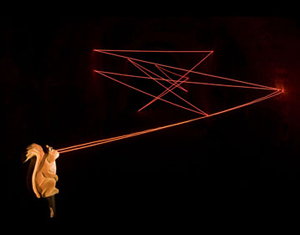 They also appear to have left long white traces with their claws. Here even lucky charms can draw blood. They have a cousin in the squirrel perched in the very next chamber. It looks cute enough give or take the illuminated red string that traces an angular path into the tunnel, starting with the squirrel's eyes, like reflections of laser vision.
Things do not get clearer any too quickly, an unlikely omen for a work about a gambler's compulsion. A black box emits low clicking noises that I did not readily identify with tumbling dice. Scattered paraphernalia take up a nearby corner, and the longest tunnel holds only a low but insistent male voice promising the world's funniest joke and, just as archly, never delivering. Only in the very last chamber does one find the game, where the squirrel's visage reappears on mysterious Eastern European currency, like the memories that some in Germany call ostalgie. By then one has no choice but to retrace one's steps and exit. As the song goes, luck "has a very unlady-like way of running out."
The three gambling tables lack the usual felt-cushioned walls. A geometric abstraction of white lines disrupts the surfaces of black sand and mirrors. I must take the Center's word that the bouncers, a croupier, and a "director of behavior" will teach others the rules and invite (or compel) them to play. I recognize the setting only by the dice, and these appear to have melted under the lights like Dalí's watch. Come to think of it, The Persistence of Memory would make a pretty decent title here, too. For Portnoy some compulsion appears to have persisted, like the marks of a rabbit's claws.
The term ilinx derives from Les Jeux et les Hommes, literally and threateningly "games and men," by Roger Caillois, a colleague of Georges Bataille. His 1958 book reflects the varied influences of anthropology, Surrealism, and structuralism. Portnoy duly describes the components of his installation in linguistic terms—as "endangered languages," "three-dimensional playing elements," and "architectonic morphemes." In practice, they appear closer to Surrealism or the postmodern still life than to sociology. Ilinx, meaning a game-induced vertigo (or "voluptuous panic upon an otherwise lucid mind"), has new resonance thanks to video games, the structured environments of American casinos, and other sites for surveillance cameras. Yet the installation remains stubbornly low-tech and barely vertiginous.
Instead of invasive public and private spaces, I thought of another Portnoy, the fictional one from Philip Roth, and his complaints. The basement's obsessive-compulsive behavior implies an unreliable narrator with a marked resemblance to its author. His voice, as on the audio track, is male, teasing, and resistant to outsiders. Roth has written better books, and SculptureCenter has had installations that I understand better. Still, if an institution is going to gamble on emerging artists, it has to take risks. Les Jeux Sont Faits.

Catherine Sullivan ran at Metro Pictures through March 15, 2008, Anna Craycroft at Tracy Williams, Ltd., through April 25, and Michael Portnoy at SculptureCenter through July 28.