|

|
|

|

|
Painting for the People
John Haberin New York City
Justin Wolff: Thomas Hart Benton
Benton's America Today
In February 1949, Thomas Hart Benton received an honor, an invitation to the White House. He must have felt he deserved it, too, but then he often felt that way. That pride runs through a biography by Justin Wolff and, as we shall see, Benton's most ambitious work, the murals in America Today, newly recovered for New York.
Nearing his sixtieth birthday, Benton had been painting for over thirty years what one series calls The American Historical Epic. American regionalism had become a byword. His murals had covered the Whitney Museum on West Eighth Street, the New School, and the Missouri State Capitol. He had represented his state in the 1933 Chicago World Fair and America on the cross as an image of World War II. His "public hoopla," as he called it, had included his memoirs and a documentary film. The son of a senator and the great-nephew of another, he was in Washington at the behest of another of the state's favorite sons, Harry S. Truman. 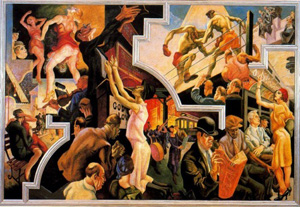
He should have known what was coming. He was meeting a kindred spirit—if one a little squeamish when it came to female nudes. "Are you still making those controversial pictures?" As Benton described it, the president "put this question in a bantering sort of way, but there was not much humor in the look of his eyes, nor did he laugh when I replied, 'When I get the chance.' " In retirement, Truman eventually had him paint his presidential library. It took less an appreciation of Benton's art than bonding over whiskey.
Pontificating as usual
As Wolff tells it, in Thomas Hart Benton: A Life, he had a way of striking out on his own, returning in triumph, and nursing disapproval every step of the way. He practically asked for it, from the moment he chose to be a painter in a family of politicians. He asked for it when he insisted on American themes for the American century, only to represent indifference, lust, greed, and violence. He asked for it, too, when he included the Ku Klux Klan in his Social History of the State of Indiana. Naturally liberals saw a spotlight on the Klan, and naturally conservatives saw the glare directed at them. Who said approval was going to come easy?
He had a way of never apologizing, often compromising, and feeling guilty about both. One can see it in his reply to Truman or his surprise at criticism of the Klan. One can see it when he takes on a history of Hollywood, only to show it as more sordid than entertaining, or commissions for tobacco companies and a department store. After art school in 1908, he headed straight for Paris and straight for Gertrude and Leo Stein. I can only imagine egos the size of his and theirs colliding, but no question who took the collision hardest. Benton "didn't know a word" of French, "the quarter was overrun with geniuses," and "I was no good anywhere."
He had come a long way in forty years from there, but the road to the White House must have brought it all back. American regionalism never received much critical respect, not even for George Caleb Bingham on the Missouri River, and he had outlived his friends Grant Wood and John Steuart Curry. That same year, his most famous pupil made the cover of Life, while his own piece in the magazine lay twenty years in the future, in 1969. He must have seen in Jackson Pollock another alter ego, right down to Pollock's mural scale, swirls of paint, physical immersion in his work, and heavy drinking. Benton had seen the triumph of American painting at last, but in the form of Abstract Expressionism—and in the New York that he had left behind. He was still painting those controversial pictures, but getting fewer and fewer chances, and Wolff traces their history.
The first Thomas Hart Benton was an anti-slavery Democrat. His father, too, was a liberal senator, with a nickname that Wolff relishes, the Colonel. Born in 1889, Benton grew up in Washington, where he saw public murals—and could not stop drawing. When his father lost a run for reelection, the boy must have felt the Midwest as a fall to earth. Before the Art Institute of Chicago, he had to survive a year at military academy as well. For the future political artist, the tension between art and politics had already begun.
In Paris he found Gertrude Stein "pontificating as usual." The description comes from the closest thing he had there to a friend and role model, Stanton Macdonald-Wright. Both were working in a dark, heavy style of portrait painting, like Rembrandt as seen by Paul Cézanne. By World War I, Macdonald-Wright became one of the first abstract painters, along with Morgan Russell, whom Leo Stein patronized. And Benton picked up their Synchromism, akin to color wheels. He was restless in the face of both Modernism and tradition.
"Realism," he explained, "is not an exact copy of any part of Nature but an effort to reproduce in paint a replica of the sensation received." He reached New York in 1912, when George Bellows and others were working out their own somber compromise between realism and early Modernism, but he missed the fabled Armory Show when his mother had a breakdown. When he wrote of the emptiness of looking within, he knew what he was talking about. He hardly fit with the circle of Alfred Stieglitz either. To hear him tell it, their modern art lacked political urgency. He found an excuse to exit abstraction with watercolors during a term in the service, but he still lacked for a subject.
Sensation received
Back in New York, he turned thirty with no hint of direction, much less recognition. Yet, Benton was to say, something crucial happened: he met a student, Rita Piacenza, and he found his first connection to that "sensation received." They married and spent time out on Long Island, where he packed human bodies into his first compositions to swirl into three dimensions. The men and women are sailing, but they look anything but at leisure. His art had become Norman Rockwell crossed with Flemish Mannerism, and so it remained for the rest of his life.
It does not sound promising, and it still serves as a put-down. Artists as conservative as Andrew Wyeth show the influence of Surrealism, plus their own gay identities. Benton has not gained their stature to this day, and he displayed a consistent homophobia. Perhaps he found himself drawn to Mannerism for its sexual anxieties, too, and his art resembles a peep show even without Hollywood. As late as 1939, he takes a break from murals to show a rural lecher leaning over a naked Persephone. One can see what worried Truman, and it was not state politics.
Still, the pieces were nearly in place. It took only two pieces of luck, a teaching job at the Arts Students League and his first mural commission. As a teacher, he could be surprisingly considerate, although he still had trouble keeping friends. While he taught life drawing, he also drew after clay models—which must have added to the tension between solidity and swirls. He loved the musculature and the pull toward the sky, and teaching demanded discipline. It also brought him close to the Pollock brothers.
Charles Pollock, the promising one, had his younger brother enroll, too. Charles also joined a band with Benton, while Jackson destroyed a fiddle in frustration. Later, Pollock made a play for Rita and an utter fool of himself. In between, they drank together, and Pollock painted Benton's son sailing. I want to imagine Benton's mural scale as an influence on Pollock, much like Guernica. I want to see Pollock's native energy, in what would become his great dance with his canvas, as an influence on his teacher.
This teacher was a slow learner, and his forties were his maturity. His art has mostly a six-year window, from 1930 to 1936—with, as will be clear in a moment, the majestic turmoil of America Today. After that, he is not making much in the way of controversial pictures after all. He paints a cycle for New York State in 1961, but Niagara Falls in the snow look more like a snow globe. He paints a history of country music for the Country Music Hall of Fame just before his death, but sanctimony has taken over. Telegraph poles sway with the dancers.
He had already passed into New York history, with an invitation to join the faculty of the Kansas City Art Institute in 1935. It got him out from the shadow of Stieglitz and modernity. Benton returned to the Midwest in triumph, just in time to spoil it with A Social History of the State of Missouri—with signs of race and class tensions everywhere. Still, those very tensions bring his work closer to Depression-era reality. For the artist, the tensions run through both history and popular culture. They haunt modern America.
Still at war
Justin Wolff found the spark for his biography of Benton in seeing the 1930 murals for the Whitney and the New School, and he treats their recovery as the artist's last triumph. And so they are, but one could not see them at the time the biography appeared. Decades before, the Whitney had moved from Eighth Street first to midtown and then to Madison Avenue, and Benton's murals for it lay in storage, while the New School sold off the murals that had decorated its boardroom in 1985. Equitable Life (now AXA Equitable) then restored them for its lobby, with curatorial help from the Whitney. Yet the building took them down after thirty years in order to renovate, and they faced an unknown future. In response to my inquiry in 2012, AXA Equitable stated that it does not own the building and was not responsible for the decision to renovate the lobby.
As of that summer, the Whitney believed that the murals would quickly reappear in the company's own tower across Sixth Avenue by Edward Larrabee Barnes, along with huge work by Sol LeWitt and Roy Lichtenstein. That December, however, AXA Equitable announced that it was donating the work to the Met, for display in the Whitney Museum's long-time Madison Avenue building once the Whitney moves to the Meatpacking District. You never know, but the Met first put them on display for nearly a year in its American wing, where they look great. They receive a somewhat selective history, with not a mention of the Whitney, but no surprise there. They also receive admirable context from accompanying text and the Met's permanent collection. It includes work by friends like Curry and Benton's most famous student in Pollock, along with a broader look at America.
America Today has a litany of motifs from Benton's time, at a fever pitch. They include blacks working alongside whites in the making of the West, with a glistening city rising by the shore. They include an evangelical preacher beneath a burlesque show, from an artist for whom everything was a morality play. They include a butcher, a lynching, and a Native American cynically tempted with booze. Despite frequent comparisons to El Greco, Benton preferred Tintoretto and Peter Paul Rubens, although he had no interest in plunging moonlit spaces or Baroque fulfillment. For him the Depression, unlike for Walker Evans or Diego Riveraand the Mexican muralists, did not confer human dignity.
He was, as Life put it, "Still at War with Bores and Boobs." It makes his paintings still worth knowing today, for all their eagerness to connect and their refusal to please. They fly in all directions, from Mannerism to modernity, as if Americans could not master their own impulses. They veer between the frontier and the metropolis, with the same clouds and fires in both. Almost every composition centers on smoke and flames—from railroads and steamships, factories and fighter planes, labor and lynchings. And almost all form two legs of a triangle, as a confrontation about to begin.
Although the New School paid little more than the eggs he converted to tempera, a mural's scale alone frees him up. It allows him to break a scene into smaller pieces, like a jigsaw puzzle, with the art deco touch of incomplete aluminum moldings weaving through. That way, he can paint his own contradictions faced with America and his true subject, between history and popular culture. Like Mark Rothko, Benton painted the subway, but above eye level and in a glare like hellfire. He shows a boxing ring and a night club, with faces submerged in buttocks and naked arms. He also asserts his politics, with a banker ignoring them all.
They were not his last threat from modernity, but they were his last concern for the East Coast. Already he is painting the American west—as a cavalcade of card players, ropers, shotguns, and fiddlers. He may know that they are clichés, but he may not care. He may even like it that way, believing that it makes his art not just more mythic, but also more in tune with popular perceptions. He is on his way to Hollywood, Huck and Jim, and Frankie and Johnnie. He has the ego now to think that he can paint for the people, and perhaps in the twenty-first century he finally can.
The threat of modernity
By his death in 1975, Benton had become a footnote to history. A lifelong Democrat, he had drifted to the right during the Vietnam War, politically as well as artistically. Abstraction was more dominant than ever, and art was more divided than ever between New York and LA. "The careers of abstract artists," he wrote, "so often end in a kind of bitter emptiness. It's the emptiness of a person looking into himself all the time." He had to face bitter soul-searching of his own.
Benton never could appreciate how much he indulged in mythmaking or myth breaking. He could look at the world around him, but he could see only around the next bend. Wolff, too, has trouble seeing the big picture. His biography has just one color insert, not nearly enough to survey the work—and never enough to present work in series. It has little by way of description or interpretation, unless to pin down a political firestorm. It has little to say about changes in style, and it lacks an extended analysis of a single painting.
Wolff has written before about an American original, Richard Caton Woodville, whose Baltimore before the Civil War hangs on the latest news. This book, though, has routine prose, with a weakness for the obvious, and turns often to biographers past, including Benton. In correcting them as needed, it can read more like a running commentary than a biography. At barely three hundred pages plus notes, it pretty much sticks to the facts. And even there it cuts corners. Toward the end, it hurries to the White House, obliging it to double back for much of the artist's final decades.
There was more of Modernism in the air than in Stieglitz's studio alone, but Wolff hardly notices. His section on the Arts Students League omits others who passed through its faculty—Hans Hofmann, for one. He does ask whether Benton's homophobia masked real urges, but having nowhere to run with this (not to mention the minor obstacle of Rita), he simply lets it go. "Do you want to know what's the matter with the art business in America? It's the third sex and museums," Benton explained, ". . . run by a pretty boy with delicate wrists and a swing in his gait." The prejudice channeled his resentment at the success of others, and it got him canned from the Kansas City Arts Institute.
Wolff starts at length with two other Bentons, those senators. And here he has a point. If the painter felt caught all his life between shame and rebellion, he had two imposing father figures. If he never apologizes, he and his father both longed for apologies. If he never fully escaped politics on the way to painting, everyone around him seemed to demand that he choose one or the other. If the father lost popular support and an election, the son will always be in search of a popular art form.
A mural painted for Truman keeps on searching, although Benton's late style strains way too hard for cold tones, sharp edges, and significance. For Independence and the Opening of the West, Native Americans stand side by side, much as for Jules Tavernier, only this time armed settlers—and they along with a Conestoga wagon are granted the triangle's peak and the last word. Blacks and women are conspicuously in the minority. Predella panels set the towns at an uncanny distance, as if deserted. A real-life hallway, visible through the door piercing the center of the wall, makes them seem that much emptier. When Truman climbed the scaffolding to inspect it, he might well have asked for a drink.

Justin Wolff's Thomas Hart Benton: A Life was published in 2012 by Farrar, Straus and Giroux. The Metropolitan Museum of Art displayed the murals in its American wing through April 19, 2015.