
|

|

|

|

|
Harlem's Late Renaissance
John Haberin New York City
Romare Bearden
The year that Martin Luther King, Jr., died may stand as a high-water mark in a decade of activism and aspirations, for all its tragedy. It also brought fresh attention to an African American art of achievement and loss. In 1968, Romare Bearden made the cover of Fortune and Time magazine. Not that he was nearly done yet. He had sixteen more years to live and to create.
A retrospective, at the National Gallery in Washington and then the Whitney, commemorates lost faces, distant voices, and an older ideal of modern art. Bearden brings that ideal into the present, by turning to collage in the very heyday of art's obsession with popular culture. Culture, for him, had deep roots. 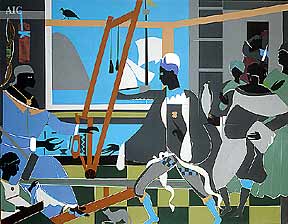
From Modernism to Pop Art
A textbook might call him a Pop artist. Romare Bearden found his voice in the 1950s and 1960s, when he appropriates everything in sight. Like James Rosenquist, he learned from billboards, for he loves both the side of buildings and close-ups on faces within. Like Robert Rauschenberg, he layers images to the point that his spaces defy easy talk of a top layer or firm ground. Like Larry Rivers, he feels at home in jazz circles. Like George Segal, he has a conscience, one inseparable from a group identity he could hardly choose for himself.
All that makes sense, up to a point—the point of his engagement with the past. In its Cubist vocabulary, urban realism, and nostalgia for small-town America, collage for Bearden could pass easily for prewar American art. He never forgot what preceded the Great Migration.
With Emma Amos, he helped found "Spiral," an African American collective in 1963, but his roots lie in early American Modernism. If he never seems a young man, in a sense he never was. Most likely born in 1911, Bearden has little to show for his first thirty years. When his retrospective really gets going, he has turned forty. He has studied in Paris and at the Arts Student League. His work of the 1940s makes me think of the brooding, crowded life of social realism, like the early work of Philip Guston, before Guston's self-portraits and Klansmen.
He prefers traditional materials to found objects, working in ink, graphite, fiberboard, paint, and colored paper. He sees popular culture not as a means of reproduction, but as shared wisdom. His is the art of the handmade. If collage suggests an art of citation and self-reference, here that means celebration rather than irony. Rather than shred the very idea of painting, it elevates the artist's sketch.
Bearden remains a humanist—in his methods, in his political and cultural awareness, and in his empathy. He takes as his subject the fate of human beings, and he takes for granted that they have desires beyond the reach of advertising. In perhaps his finest work, approaching the middle of his career, he shows a city block as a teeming community, and each tenement window has a story to tell. One can all but hear the children crying. Even the metaphor, of art as a window onto reality, roots him in tradition.
It is a distinctly American humanism, as funky and as ordinary as a Harlem street corner for Roy DeCarava and Gordon Parks. The curator, Ruth Fine, departs just enough from strict chronology to bring out its character. If Stuart Davis or Charles Sheeler updated Cubism for a demotic America, Bearden updates Davis for the mid-century black experience. Like Davis, he offers, in fact, an alternative history of Pop Art. Sure, one can call Pop Art a radical turn against Abstract Expressionism, an embrace of the movement's epic scale, or a displacement of time and space comparable to Surrealism. Bearden, though, knows that American Modernism always lived high and painted low.
Paradise lost
His nostalgia addresses art's distance from the past. It includes as well a black man's distance from self-definition—and the isolating force of a modern city. His sense of community drives his 1971 The Block and the Bearden Project in his honor. Yet it does not exclude helplessness. Other apartments may or may not hear a baby, and they have no power to stop the crying.
It never does makes sense to speak of Pop Art as nostalgia. Its recycling offers too thoroughgoing a critique of presence for that, even when Andy Warhol shows his love for mass culture or Roy Lichtenstein for the painted brushstroke. And for Bearden more than anyone, a feeling for the past requires a sense of the present, in all its transience. This is an art of both commemoration and loss, and he takes each loss personally. He knows the long view, but he prefers individuals.
When Rauschenberg quotes the expulsion from Paradise, he reduplicates the fall from grace. He places Adam and Eve beside John F. Kennedy, spaceflight, and another silkscreen image from art history. America and art share responsibility for the sin of pride, and even the satisfaction of punishment has grown as remote as myth. For Bearden, though, the motif takes up an entire composition. Adam and Eve exit to the right—at a very real distance, in a very real garden, and with a familiar human face.
It is also a black face, expelled from the garden by white angels. Bearden's consciousness of exile is definitely social. He came to New York in the wave of northern migration, and he knew life in the ghetto. He knew the years it took a black man to establish himself as an artist. He knew the slow rhythm of the passing freight train, the rhythm of Watching the Trains Go By.
Bearden's consciousness of exile is personal as well, almost to the point of an "outsider" artist like Thornton Dial. Maybe it goes back to his move from Mecklenburg County, North Carolina, at just three years old. If anything, it increases with age and with his recognition as an artist. His work has more memorable images of strong women than of men, and he has more of them as he gets older. He also has more and more rural scenes, many named for his birthplace. In his very last work, softer washes and gentle recollections turn even the midtown Manhattan of his twenties into a garden.
His consciousness of exile reflects Bearden's core empathy. It would resonate with many a European in exile as well, like Marc Chagall as a Jew. Jacob Lawrence depicted migration as a mass movement and black men as builders. Bearden's collage fills in the gaps in history, and he sees people as particulars. At the same time, he sees an African American's tale of exile and return as the human condition. In the 1960s, he shows the return of the prodigal son. In the one classical theme in his retrospective, a series tells of the homecoming of Odysseus.
All that jazz
Bearden also briefly tried his hand at abstract art. Why then did he return to collage? Because he knew.
He knew its rhythms. As perhaps the best-known African-American modernist, Bearden will always enter textbooks as the artist of the jazz era. He knew it at first hand, as Barkley L. Hendricks with "Birth of the Cool" (and raids on European painting) in the 1970s could not. Nothing appears as often as jazz—at the Savoy in Harlem, in Kansas City, or in Mecklenburg, just outside of Charlotte. He loves the men with cigarettes and fedoras, staring ahead or strumming a guitar. His was an improvisatory art, and he knew the score.
He loved cutting things up and putting them back together, from a tin-foil hat poised like the mute for the musician's horn to actual musical scores. A centennial exhibition of collage alone, six years after his retrospective, begins in 1964, after Rauschenberg had put combine paintings front and center and when "Sixties Surreal" and Pop Art were all the rage. When King and Queen of Diamonds borrows advertising to serve the couple their whiskey sours, Bearden was just keeping up. Well into his fifties, he was keeping up, too, with the anger and awareness of Tenement World, in 1969. The show ends in 1983, five years before the artist's death, when irony and appropriation were all but crowding out painting.
His retrospective has collage, too, of course, and one can easily take it for granted. It helps him keep things open, and it fits with his aspirations to take on more. He is still taking on more in 1977, returning to myth in a Fall of Troy with black warriors. There the blade of a knife plays right to Bearden's strength in drawing, with simple curves that outline men and women together. 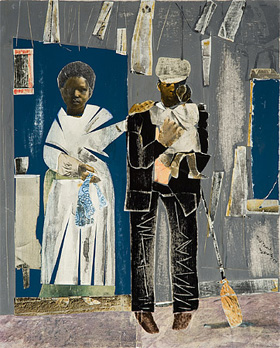
At the same time, collage reins in his ease, by forcing him to make connections. Maybe he does have those whiskey sours, and magazines supply his Fish Fry with outrageously large flatware. More often, though, he puns on colors, shapes, and textures, like the pattern of print dresses or the casual note of a collage element peeling off the page. He is still the elder modernist, happy to look back to Picasso's Cubism after all those years, just as with the sheet music. He does adopt what the 1980s liked to call rephotography, as with Richard Prince and Sherrie Levine, when he actually eliminates the knife edge by photographing his own assemblage and then abrading parts of it away. Yet he defers to his sources without cynicism, and he is rephotographing only himself.
Ultimately, collage intensifies that confrontation of closeness and distance. Bearden can seem a gentle soul, waxing nostalgic for older jazz styles and a man's world. Still, he knows how much that world has suffered abrasion—and how much of it lies in the past. He can tackle the poverty and emotional distance of a woman in white and a man in black holding their child. He can picture a skeleton lying on the city street, in front of a rigid line of what could equally well be mourners or gawking onlookers, all beneath a smiling skull.
Activism and nostalgia
Bearden's fame coincided with a resurgent political activism. He shared a renewed urgency to forge an African-American identity. As with the expulsion from paradise, though, he finds that urgency fully compatible with old traditions. When his Odysseus comes home, the elegantly posed, turbaned hero pays homage at once to Pintoricchio, the Florentine artist, and to Benin. When he portrays two maternal figures joined in friendship, again in his retrospective, he quotes a Renaissance Visitation by Piero di Cosimo. And why not, he might add, given the role of the church in black neighborhoods?
He can pay a price for his humanism—the price of complacency. One has to wonder now and then about all that good nature, especially in the country gardens of his last years. He became everybody's favorite black artist because he made black culture as familiar as old melodies. One can almost forget that his first solo show, in Harlem in 1940, came after the Harlem Renaissance that Winold Reiss documented i painting. When he portrays jazz musicians, he ignores the avant-garde of his own day. Not surprisingly, he became friends with jazz's most noted cultural conservative, Wynton Marsalis.
One can mistake Bearden for an older artist, not just because he admires the past, but also because he has trouble letting go of it. His next most common subject after jazz is the female nude. Nor is that refusal to let go so bad: counting the losses and nurturing hopes matter, too. The other Renaissance, the one in Italy, did so, with the period known as Mannerism. And that period, too, could turn perilously slick, deeply poignant, or both at once.
The Whitney has Lawrence's war series on display, too, just a floor above. Call it one more proof that art after the invasion of Iraq still cares about brutality and suffering. Lawrence's figures adopt large gestures, rooted as much in German Expressionism as in folk art. Bearden's smaller, more individualized characters reflect his roots in a later art, the art of the 1930s and 1940s. For all their life in exile, they never come near to outrage. Perhaps he experienced exile too closely to dwell on it in the same way.
Still, Bearden's consciousness gives him depth and warmth. It contributes to his preference for easily legible compositions. It helps him keep people front and center, no matter how busy the collage. It helps him turn black skin, earth tones, night in the city, and simple clothing into a coloristic vocabulary of his own. It supplies a moving alternative to Abstract Expressionist's primary colors and to Minimalism's cool industrial hues. The knife can give him an edge that one never fully knew.
Nostalgia can mean an escape from reality past and present—or a heightened awareness of both. At his best, Bearden keeps them both up in the air.

"The Art of Romare Bearden" ran through January 9, 2005, at the Whitney Museum of American Art, Jacob Lawrence's "War Series" through January 31. Bearden's collage ran at Michael Rosenfeld through May 21, 2011. Related reviews look at "The Bearden Project," also in honor of Bearden's centenary, and to Romare Bearden as an abstract painter and "The Block."