|

|
|

|

|
Making It Big
John Haberin New York City
Ron Mueck, Dana Schutz, Neo Rauch, and Tom Thayer
Can shows grow any bigger? Can an artist's celebrity? What about the artist's ego? And whatever happened to mine?
As today's art scene expands, so does the pressure on artists to become legends in their own time—and for their art to believe in its own myths. With Ron Mueck, for one, sculpture has truly grown to epic proportions. Even an infant can fill a room, and every instant is a matter of life and death. 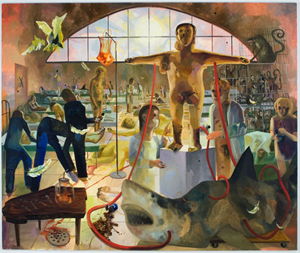
Dana Schutz is not one for garden parties. Her mythmaking can be pretentious indeed, but also big, bold, and entertaining. It gains from colors, planes, and a "primitivism" that go right back to Cubism—and from a healthy dose of ordinary summer fun. What she calls Fight in an Elevator seems mostly to take place outdoors, where a mature couple at the beach upstages some nasty sex. The victim of the fight sleeps within the jaws of something between an owl and a cat. It would only spoil its triumph for it to bite down.
Formalist criticism liked to distinguish size from scale. Late Modernism insisted on the scale of a museum piece, whatever its size. In the same way, one does not need to work big to create a myth. Schutz and Neo Rauch have actually discovered easel painting as if for the first time. Yet New York's hot young artist and Leipzig's elder statesman still want to contain multitudes. A postscript catches up with Schutz five years later, along with more trends in mythmaking, like Tom Thayer.
Giganticism
Ron Mueck executes sculpture with astonishing realism—give or take color, textures, subject matter, and most obviously size. Another purveyor of bare flesh, John Currin, delights in lust and artifice. Mueck, in contrast, offers a surfeit of dismay and sincerity. His highly selective world resembles Currin's in its focus on youth, age, and the naughty bits in between. Its inhabitants just happen to come unnaturally large or small, like the proverbial elephant in the room or the object behind the peephole.
Mueck meticulously paints fiberglass resin to resemble an infant, a man strangely alone in a boat, or a "spooning" couple. Mostly, however, he fabricates weathered skin, often based on himself and his immediate family. He might have drawn their huge hairs from the coat of a wild animal.
Outsized private parts may recall the Chapman brothers, and they should. Mueck, an Australian, came to Brooklyn before with the Young British Artists of "Sensation." However, his brand of shock art lies between the curiously American poles of Duane Hanson and Kiki Smith. Like Hanson, he tries to stun more with his photorealism than with his nudity. Like Hanson, too, he uses the illusion of familiarity to discourage desire: he finds a heightened degradation in the everyday. His elderly women with rumpled coats and frazzled hair could be off to meet Hanson's bag lady.
At the same time, Mueck is in search of the bruised and battered human condition. Hanson's art seems so public and so forgettable, Smith's so intimate and so very much alive. Yet they both bring out Mueck's sentimentality. He wants to keep up both convention and a pretence of emotional purity. His naked, new-born baby has all the effrontery of Macbeth's metaphor for pity. It also lacks Shakespeare's fear, puzzlement, and compression.
His pale, plastic hues, all but devoid of human veins, only add to the unfortunate exaggeration. Perhaps Australia's blood has simply run cold. Mueck's device works best with a woman shrinking under her bedsheets, like a limp body for Dan Herschlein, as if torn from a horror movie. This once, one remembers not skin alone, but rumpled sheets and the uncertainty in her eyes.
Art like this may seem provincial to a New Yorker, but it says a great deal about the aspirations of art in the hot market here, too. I have looked elsewhere at the pressures to think big, from Matthew Barney and Chelsea's fall openings to installations that trash the joint or jackhammer through the floor. Two summer shows at P.S. 1, by Tunga and Jim Shaw, also traffic in the artist's private mythology. Art's traditions, processes, and financial pressures will not change overnight. Still, two hot artists seem to be working through their own ambitions and their own success. Take Dana Schutz and Neo Rauch.
How we would paint
A burial scene by Dana Schutz barely made it out the door of her last solo show before it turned up at the Modern, in "Take Two" of the new contemporary galleries. One can see why. Her huge heads, bulky physiques, layered objects, cramped spaces, large scale, earth tones, and symmetry aim big. They fit naturally into the same museum as Pablo Picasso, as an extension of his wrestling with "the primitive." This young artist, they intone, has been around for a while. And that would hold even if a few months of hype did not already seem an eternity.
For all that, Schutz has lightened up. At least she has grown more at ease in the present. Her characters go for a drive, throw a party, give birth, or write Dad in the sand. Her largest scene could pass for the art class in which one learns to paint such bulky models. Their clumsy anatomy has me thinking of a "bad girl" now as much as African art. She can work on an easel scale, too—at times close to abstraction.
Anyone can grow sick of "emerging artists" as rising stars. One might be reassured by a show called "Not for Sale." Still, her newfound modesty is deceptive. Dad and motherhood have a sneaking resemblance to timeless themes. So does the futility of writing a name in the sand, a traditional metaphor for human hopes and desires. On second glance, that anatomy class looks like a laboratory, where experts can lecture on human nature or disease.
The party, with a woman's head thrown back violently, has descended to a primal dance. Cryptic strokes of white paint or cuts in the canvas itself cross the nighttime interior, like runes. The birth scene alone goes for broke. Its hospital bed coupled with interior decor wavers between the personal and the clinical. A Hudson River School landscape hangs right behind the woman, linking the female body to the course of human life and to the sublime. The baby crawls out on its own, in a superhuman burst of activity and a trail of blood.
Schutz is still playing the anthropologist—only now with an eye on contemporary America, where driving comes as close to the human essence as birth and death. Those larger scenes turn out to represent How We Would Cure the Plague, How We Would Dance, and How We Would Give Birth. They sound like headings in a textbook. Like that of Remy Jungerman, her anthropology also turns its eye on the art world. Curing a real plague might indeed involve a quarantine of MFA classes. Schutz could explain how.
Schutz is still up to something out of the ordinary. She still mixes high style with wild execution—and big stories with a familiar cast. Have her titles become funnier? More likely, I am just starting to get the hang of her ability to let irony not get in the way of her confidence. Perhaps she has studied the same culture all along. One can see the crowded funeral as a big affair, for the best of friends.
"Para"-bles
Neo Rauch has not turned fifty, but compared to Schutz he is already an elder statesman. His art—one part expressionism, one part Socialist Realism, and one part sheer fantasy—has defined a Leipzig school. Another German artist, Michael S. Riedel, even followed Rauch's 2005 New York show by reproducing it. Riedel displayed installation photographs as inkjet prints across the very same gallery walls. How fascinating then that Rauch uses the Met to explore, tentatively and self-consciously, his place in a museum.
Rauch spills just over one small, cramped mezzanine gallery, often reserved for works on paper. He may already have in mind the exhibition title, "Para," Greek for beside or beyond. A dozen works range from easel paintings to his usual large scale, as if he is trying them on for size. He may be trying the museum on for size as well. In another sense, smaller canvases let him agonize over himself again, compared to the crowded, more crisply painted works in 2005. His style loosens up, and he focuses on a few enigmatic characters at a time.
Para has some nasty associations, as in paranoia or the paranormal, and Rauch revels in them. He likes muted artificial light, horizons that interrupt sunlight with blank earth and hills, and scumbled earth tones broken by half-finished patches of intense blue. The smooth brushwork leaves the bulky human forms unfinished, as if birth defects rather than the artist crippled their hands. He alternates between cramped interiors and outdoor scenes at the border between decaying cities and an unproductive nature. He may give the effect of a stage play, in part to put creative types like himself on the spot. His musicians seem not to know what to do with themselves backstage, and a young man, dressed in a richly colored riding coat, strides across a tray of paints while strapped to a makeshift easel.
No one, not even hunters or laborers, seems to accomplish much, although not for want of trying. When Rauch introduces disjunctions in the scale of his figures, his actors have to cope, too. Two pile onto a much larger man, as if toppling a Communist-era monument to labor. In Father, an adult clings to a still larger man dressed in finery more suited to the eighteenth century. A few blond girls, in skirts from the Nazi era, float about to no obvious purpose. Clearly Rauch's Germany has no end of father figures—and a problem or two with them all.
It makes sense that Leipzig stands apart. East Germany could easily have missed a few explosions in German art. It could not indulge in the Neo-Expressionism of the 1980s, like that of Georg Baselitz. It could not yet reflect critically on its divided past, like Anselm Kiefer, or on Modernism, like Gerhard Richter and Richter's late work. It lacked the infrastructure and modern museums that inspired photographs by Thomas Struth. All it had was a famous university, along with way too many pasts.
Rauch still frustrates me, as even those other German artists may not, and I still take comfort in Schutz and other examples of a homegrown American Surrealism. He is content to paint his own dreams in the styles of others, like Max Beckmann, a Beckmann self-portrait, and Beckmann in New York without the Vikings or Balthus without the sex. He takes the shocks out of Surrealism and the coherence out of history painting, because he cannot accept their different ways of leaving the past behind. He finds a human comedy in everything, including his own art, but with the comic timing of a storm trooper. Yet all these make a fair case for an artist, and I am starting to look forward to complaining about him. Call it a paradox.
Postscript: wake me when it's over
Could there be a homegrown American Surrealism? Of course, as the Whitney has pointed out, there was, only it was very real. Between artistic conservatism and the activism of the Depression, "Real/Surreal" found it turning to factories, subways, and deserted streets. That gave it the resonance and clarity of Edward Hopper and Hopper drawings, if at times a limit to the dream. Now, though, with the backlash against big-ticket installations, art has seen more calls for paint and personal expression—an almost Freudian obsession for Roberta Smith and Ken Johnson in The Times. And that leaves more time for dreaming.
The 2012 Whitney Biennial had plenty of it, including maybe the poster child for the insider's version of outsider art, Nicole Eisenman. Naturally the backlash often takes the form of an installation. Online, Tom Thayer's gallery welcomes one to his new exhibition with an installation view from the Biennial. In person, the Biennial displayed Jutta Koether's Four Seasons on three easels in the round. And for her latest, her gallery instead puts them back on the walls—along with a fifth season and, from the back, a properly curious cat. Her cross between nature and abstraction remains colorful, airy, and light.
Thayer, too, constructs at heart less an installation than a mythology, and much of the myth is the artist. One can see his hand on video, applying thick daubs of paint—which just happen not to match the thin layers of color and peeling paper on canvas. One can see his traces in the exhibit's very center, a long table of artist's materials, which may or may not scatter about to the walls and floor. One can imagine his nightmares, in the deep reds and blacks. One can imagine his dream companions in the black paper birds and human silhouettes.
Like the very vogue for trash that everyone loves to hate, he never pretends to a coherent narrative or a coherent space. He does, however, have a consistent cast of characters and a story to tell. "Crossing the Methane River" sounds like a passage into death or into a swamp, but it looks as urban as most New York dreams. It involves birds descending and people rising, their hands and profiles given a sense of action by the sheer contortions of flattening them onto canvas. Like most dreams, it never quite gets to the point and never quite lets go of things one should have tossed out long ago. Wide-awake people will know the feeling.
Dana Schutz got a jump on the trends for primitivism, painting, and mythmaking, all while obsessing about her own art. Her bulky characters posed for a grand vision of the artist's studio and for their own burial. More than five year's later, she is even more detached and more over the top. The detachment shows in five different versions of a yawn, either from late nights in Brooklyn or the wrong companion—whether her unconscious "other," the buyer, or you. The excess shows in a man with a sparkler, as if his ear were on fire, and a man shooting up, his hair to the wind as if aflame. A crowded beach scene has everything from hipsters on the boardwalk to a man with one arm stretched against the wood as if crucified, and swimmers could be bobbing or drowning.
She calls it Building the Boat While Sailing, which suggests a certain modesty and a weakness for metaphors. The couple in Small Apartment could be a character study in reaching for intimacy while unable to attain it. She has lost something of her painterly blocks of color, although the lighter palette and greater emphasis on drawing plead for simplicity. The show's title painting, Piano in the Rain, throws in everything she has—from the improbably subject to the hunched pianist's fevered gesture. Raindrops convert the white cushions of piano hammers to a flurry of pure color. Ponderous or not, these dreams are getting closer to the truth.

Ron Mueck's sculpture ran at the Brooklyn Museum through February 4, 2007, Dana Schutz at Zach Feuer through May 19, and Neo Rauch at The Metropolitan Museum of Art through October 14. Jutta Koether ran at Bortolami through June 16, 2012, Tom Thayer at Derek Eller through May 26, and Dana Schutz at Friedrich Petzel through June 16 and again through October 24, 2015. Related reviews look at controversy over Dana Schutz and the Whitney Biennial.