|
|
|

|

|
Trashing Chelsea
John Haberin New York City
Installations: avaf and Alexander Lee
Kai Althoff, Nick Z., and Andy Goldsworthy
Are artists competing to trash the gallery as thoroughly as possible? With so many big, unruly installations, it sure seems that way. You may not find beauty or coherence, but that amounts to a tautology. You may not find much in the way of significance either. But explanations? No problem.
It all comes down to a tension—between real-world anxieties and pressures to act them out in public, big time. They amount to two sides of the art market, and plenty of artists are competing for it. avaf and Alexander Lee take comfort in catastrophe—and hint at how the trend got started. Kai Althoff and Nick Z. and Andy Goldsworthy then show how far it can go. They compete to turn a gallery into a battlefield, a disco, a natural disaster, a trash dump, or maybe Santa's workshop after the toys went south. Clearly art is in a mess. 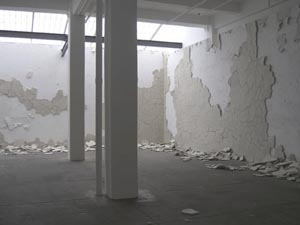
Fighting fire
With the "war on terror," art became a political battlefield—and not only in Iraq. Just to make art about the headlines can make art the headline. And to make art about censorship can subject art to censorship. A group act even calls itself "The Horror Show." But has the battle died down a bit? Do gallery-goers now take torture and war for granted? Two shows suggest just that.
Alexander Lee displays what look like charred limbs, amid a huge pile of black gunk. Even if war did not reduce entire cities to ashes, the remains would recall the term firefight. Yet Lee calls the substance black sand, and he relates it to a creation myth in Tahiti. Lava spawned fish and, ultimately, populated the earth. It sounds downright inviting. Cross Tenth Avenue, and enjoy an island vacation and a better planet—if you dare.
Two doors down, artists paper a gallery with slightly staggered red, yellow, and blue words, like pulsating newsprint. The same "3D wallpaper" covers objects propped against the walls. The flattened furniture and broad straps appear as puzzling and threatening as the sign pointing downstairs. Given a choice of words like Bush, Iraq, and evil, could I help mistaking a "multi-disciplinary room" and a dark cellar for a military prison? Yet avaf, an artist collective that also appeared in the 2004 Whitney Biennial, tries not to make the words too legible, and stairs lead to a neon logo about as upsetting as Citibank's—and even less meaningful. It could give new meaning to the banality of evil.
My mistake could have arisen just as easily with handmade plasterboard by Erik Sommer and Kadar Brock—or Rudolf Stingel with his blurred carpeting and wallpaper. It could say something about America's anxiety, anger, and fatigue as well. avaf calls its show "a very anxious feeling." Then, too, this art could simply have trouble getting its point across. Multidisciplinary also means a crossing of ideas and media. And avaf has built a reputation on a fashionable combination of big installations and visual overload. It adds a vague rehash of pop album covers, as in the nostalgic 2006 Biennial and the Whitney's 2007 "Summer of Love."
avaf could stand for the art scene and its obsessions. The group touts a new notion of the artist collective, not as community but as slacker celebrity. For its press kit, it poses in masks like a major-label band on a publicity shoot. Its full name, assume vivid astro focus, might translate loosely as "short attention span." Its anonymity, of "artists born anytime between the 20th and 21st centuries in various parts of the world," serves not as a disclaimer of authenticity, but as a guarantee of exclusivity. A similar shift in stature occurs when Rirkrit Tiravanija repeats his free lunches in Chelsea's largest gallery.
Nonetheless, both shows should make anyone anxious. Perhaps war has sunk so deeply into the psyche that it merges easily with other dangers. A "disciplinary room" might mean a sexual turn-on, and avaf's wallpapering includes the words homo, dyke, and anal. Fernando Botero, too, has used Abu Ghraib to air his sexual preoccupations. And Lee's creation myth promises that trauma may yet spawn something. His black remains can almost give me hope.
White trash
Creative destruction, then, comes with at least three goals, between installation and architecture. One is to deal with real conflict, one is to make a smash, and the last is to leave room for growth. Moreover, the shift from old media to installation did not happen overnight. Starting in the 1960s, artists exploded the whole idea of an art object and broke through the gallery walls. Yet markets demand objects, and they demand growth, much like an obsessive collection. Put those together with anxiety about the future, and you have a recipe for an explosion.
Long before his Torqued Ellipses, Richard Serra left heaps of torn rubber, while Elizabeth Murray both shaped and split canvas. Robert Smithson brought in shattered glass and stone, and Gordon Matta-Clark burst right through the roof as Day's End. Jeff Wall creates a small room only to tear it apart—and, in turn, so that he can photograph it the ruins. Phoebe Washburn, Julie Mehretu, Sarah Sze, and "scatter artists" like Jessica Stockholder all turn entire galleries into structural diagrams of chaos. So have all sorts of bad boys and bad girls. Matthew Ritchie has even invoked the Apocalypse.
One can start to take wall-to-wall debris for granted, like yet another curry or espresso bar from Tiravanija. The celebrity artist has departed, leaving only me to rattle around the interior. Will Urs Fischer savage another wall or concrete floor? Just last month, at Ritchie's own gallery, Elliott Hundley played this year's model. He hauled out the same mix of painting on canvas, wall drawing, free-standing sculpture, gallery renovations, and prophecy. But what can this fashion for installation art mean for the artists? Art has a dozen answers.
Like Jonathan Schipper or Olafur Eliasson and his art as science experiment, they can be celebrating entropy as a natural or creative force. They can mean it as a threat, but one that gives the space of the gallery and the viewer a chance to fight back. They can be wrestling with art itself as an ordering or subversive spirit. They can see art as expression or catharsis. Like Joshua Neustein, they can be responding to the revival of old media like painting alongside new ones. In fact, they are demanding to include both together.
They can enjoy the "burgeoning geometry" of New York City or of commodity culture. They can seek an escape from the marketplace of art and its dozens of niche markets. They can be embracing a crowded marketplace, in which art has to make an instant impact. No wonder the worst excess gravitates to galleries large and wealthy enough to display it, while the most evocative empty rooms lie elsewhere. They can mirror a society haunted by terrorism and global warming—with the feeling, as one recent show had it, that "The End Is Nigh." Call it the anxiety of influence.
Why, then, do artists feel obliged to trash the gallery that is giving them a shot. And why does a gallery or a Whitney Biennial submit to it? In short, the partners in crime seek each other out, to legitimize their status as superstars. On the one hand, the artist acts as a force of nature—with the artist as mythmaker. At the same time, a larger system absorbs and degrades every personal gesture. In the process, the players scale up these themes for an era of posh galleries, celebrity artists, and short attention spans.
Boys will be boys
One way or another, galleries are determined to discover the largest dump site, in a macho scene for which size matters. Does it matter whether the mess means more than the chance to know the price of everything and gawk? Does it matter that Matta-Clark died long before Chelsea's largest gallery set out an old van in his name? Does it matter if, in inviting visitors to add graffiti, it rehashes an urban cliché of a generation past? Yes, these things do matter. Quantity alone does not offer an artistic challenge.
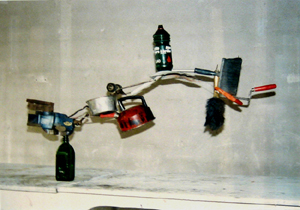 It does, however, let artists have fun—and so, at times, can visitors. At least Kai Althoff and Nick Z. are having fun. They pile in all the expected elements, from painting and wall drawing to sculpture, found objects, and physical alteration of the space itself. Mostly, however, they get to make a colossal mess, with the emphasis on the colossal as much as the mess. Their mess fills both sides of the huge, partitioned main space and both side rooms as well. They dare you, even after two or three visits, to remember a single object or image, much less what it might contribute to the whole.
To emphasize the overkill, the German superstar and graffiti artist throw in not one but two cockeyed, cramped, half-open sheds. A painting has jagged edges out of early Elizabeth Murray, and two hyperactive young men spar within it. Everything signals a childlike glee, from spray paint and cartoon faces to colorful bedsheets, snappy messages, and drawings stuck on the walls as in elementary school. It amounts to a child's fantasy of grown-up rebellion, right down to the jar of cigarettes at the desk, for sale at a quarter each. See, it all says, we refuse to stay in until we clean up our room. As the title puts it, We Are Better Friends for It, just like Calvin and Hobbes.
Shows like these pretend to destroy an influential part of the art market, but only pretend. At the same time, their scale requires a massive task of construction, like Peter Fischli and David Weiss in The Way Things Go, where they turn destruction into a metaphor for creation—and even a fragile equilibrium. Andy Goldsworthy plays on exactly that ambiguity, between construction and destruction. He merges natural processes of demolition with his own. His show, too, amounts to simple theater, but with quite a stage set. As entries in the "trash your gallery" sweepstakes go, this one will be more rewarding than most to clean up at the end, and one can better appreciate artists like Paul Gabrielli who do the cleaning for one.
A sign warns visitors to stay near the center of the room. It may be looking after one's safety—or and the gallery's liability. It also underscores how much one wants to get closer. The walls are peeling, and inch-thick white fragments lie everywhere on the floor. I wanted to reach out for the familiar touch of Sheetrock, but in fact the artist lined the gallery with porcelain clay. He had no idea how long it would take to crack, but after only three days it had pretty well fallen away.
The caked substance alludes to the artist's home territory, in Cornwall. Like Richard Long with his walks, Goldsworthy is measuring geologic space and time in England through his own spatial and temporal gesture. And the more nature takes over, the more the work comes to be. White Walls also describes the white cube of a gallery, at once empty and increasingly full. Ironically, the gallery's home page displays a more pristine version of the same space. Think of the universe before the Big Bang.
avaf ran at John Connelly Presents through June 30, 2007, Alexander Lee at Clementine, through May 26, Elliott Hundley at Andrea Rosen through April 21, Gordon Matta-Clark's recreated shed at David Zwirner through May 19, Kai Althoff and Nick Z. at Barbara Gladstone through June 16, and Andy Goldsworthy at Galerie Lelong through June 16.