|

|
|

|

|
Newish Media
John Haberin New York City
Cory Arcangel, Tim Hawkinson, and Charlotte Becket
Artists definitely know when to play around. They can serve as consummate tricksters or the ghosts rustling in a culture's closets. Art itself may have its roots in very grown-up needs for play, the kind that leads to serious experiment and real discoveries.
Sometimes, however, artists come off more as kids obsessed with the latest toy. When they do, it can affect how one looks at new media—or where one draws the boundary between an installation and interactive art. 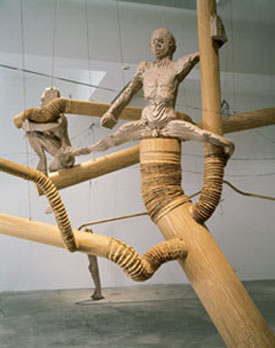
That boundary can look most rickety when the work of art looks that way, too. To make painting reflect on its material reality, geometric abstraction sought to eradicate its rough edges. When some artists want to push at the limits of an increasingly high-tech society, however, they may become downright nostalgic for low-tech contraptions. Consider some recent exhibitions from Cory Arcangel, Tim Hawkinson, and Charlotte Becket.
Whenever one looks at digital art, in fact, one is placing it in a tradition—but especially when one seeks its origins. More maddening and, I think, more fruitfully, one can place it in a web of conflicting traditions. Start with the artists, before wrapping up with a few paragraphs to try out some of the conflicts on you. They have come up so often on this site that, appropriately enough, I get to rely on hypertext. Try not to click too fast. And then decide for yourself when galleries get a little too close to toy stores.
Hacking away at fine art
Cory Arcangel stood out two cold winters ago, in "Alt Digital Media," a show at the Museum of the Moving Image. I Shot Andy Warhol, his arcade game that allows people to take aim at pop-up cartoons of the master of replicas himself, had an ear for the art world and its media icons, a hacker's distrust of copyright law, and a politically incorrect license to kill in the name of digital art. And it had the viewer's—no, make that the player's—eager involvement every step of the way. In more ways than one, it had all the right targets.
It also had a studied simplicity. Is that at odds with the very idea of digital media? Is it back with Mike Kelley and Michael Smith and their toys? In fact, the entirety of "Alt Digital Media" avoids extended narratives. Its small-scale work prefers John Lennon and lava lamps to the sensual overkill of Bill Viola of the dark metaphysical puzzles of Gary Hill. So what if slackers like Maurizio Cattelan turn a retrospective into gigantic toy store?
Other artists, like Terence Koh and Anthony McCall, make a movie projector light up more than it ever could in the theater. Arcangel based his projected image on the earliest video games, and he handed me a plastic gun rather than a joystick. When his gallery gave Warhol pride of place at the 2004 Armory Show, players relaxed on a sofa rather than hunched tensely over a video console. One could wallow in it—or write it off as retro chic. Both are tempting enough, in a work all about temptations. Only time will tell whether he learns to aim carefully.
Arcangel's first solo show in Chelsea has all the retro trappings, under cover of an assault on cheap commerce. It suggests a savvy, post-adolescent hacker fondly recalling the technology and culture of his childhood. Nintendo and other early games are back, one as an unending cartoon road into a distant nowhere. The Beach Boys take their bows and vanish on the small screen, only to return again and again for a single drumbeat. Simon and Garfunkel deliver a decent enough performance of "The Sound of Silence," even if colors go a bit out of whack and a hand intrudes in the foreground. Doogle, a Google clone, accepts no input and returns only hits for Doogie Howser, M.D.
Arcangel must have loved Howser—another bright adolescent whose career required math and science. He must have loved, too, that the sitcom began in 1989. From the age of penny arcades to the era of video games or a whole amusement park by Carsten Höller, the artist skips happily over the years of punk rock and the East Village scene. He must hate that those kinds of nostalgia are so hot in Chelsea right now. For an ancillary show, in an equally trendy spot downtown, Arcangel offers the complete code of his reworked Super Mario. Ah, for the good old days when hackers had cooler stuff than viruses on their mind.
Call it nostalgia as anti-nostalgia and art-world glamour as anti-glamour, and Rirkrit Tiravanija does much the same thing. But has its irony lost its bite? As with Doogle, Arcangel gives up any pretense of audience participation—unless, of course, the viewer, too, has fun writing in NBASIC. Even when he covers that entire wall with code, he turns open-source ideals into little more than wallpaper, and no hacker could ever copy it all down. Arcangel is savvy enough to make fun of his down-to-earth roots. Yet that, too, risks the detachment of easy smiles.
Having fun yet?
Whenever new media get low tech, Hollywood has a way of breathing down its neck. One year ago, the Guggenheim broadened a textbook view of Minimalism geographically, temporally, and visually as well. "Singular Forms" began very close to the present, with large resin blocks in firm rows on the rotunda floor. I marveled that repeated units out of Carl Andre had acquired such transparency and color. And then I caught onto the mutual displacement of museum spaces and sculptural form, of found objects and created memories. Rachel Whiteread, the British artist, had set out casts from the underside of ordinary chairs.
As I ascended the ramp, I saw more and more luminous works, often from beyond New York. I had attained at last a Southern Californian's idea of Minimalism. I started to imagine a studio director, after a suitable focus group, stopping by Soho ages ago—or Dia:Beacon now. Wow, absolutely fabulous, but do you think you could try a little color with that? Just something to liven it up, like all that great product placement in Pop Art. And while we are talking about a cast, how about Tom Cruise and Nicole Kidman sitting on those chairs?
I heard that voice again at the Whitney, with Tim Hawkinson. Hawkinson studied with Charles Ray, a kind of delayed L.A. response to Marcel Duchamp. Ray offers a subtle but playful response to conceptual art. He shares Duchamp's ability to insert himself into the work, although without the provocation of cross-dressing. Hawkinson takes that insertion one giant step further. He seems determined to remove the conceptual confusion from conceptual art or the imperceptible from Minimalism.
Like Ray, he loves the found, the familiar, and the homemade. Like Ray, too, he includes his own slippery presence. Hawkinson's contraptions range from a tree stump or robot made from cardboard to clocks fashioned from a Manila envelope and a tube of toothpaste. They shift in scale from a creature made of nail clippings to an entire room of madly clicking primitive men. His grandest work, filling a midtown sculpture court with metal and balloon tentacles, resembles the undersea creature in an Imax film. When in doubt, however, he starts with his own body, leaving its traces from ink in a bathtub or its weight in an oversized pair of cast-metal feet.
As with art as science experiment from Olafur Eliasson or Rain Room, part of Hawkinson's charm comes from his ingenuity, part from his close connection to the materials at hand. He prefers what structuralism called bricolage, or tinkering and making do, to formal conceptions of art and science. Part of his charm stems, too, from his modesty—and his sharp eye on the very idea of self-expression. He allows chance mechanical fluctuations to twist his eyes and mouth into poor excuses for a self-portrait. He creates a machine to churn out endless, clumsy facsimiles of his signature. Much, however, has no particularly pressing associations at all.
Like Arcangel, Yayoi Kusama, or even Tom Sachs, Hawkinson encourages a certain nostalgia. He uses the improvised as a rebellion against the computer age, just when Dan Flavin's neon lights have given way to Jessica Bronson's LEDs. No wonder he includes LPs, old-fashioned music boxes, and those primitive men—modeled, naturally enough, after himself. That undersea creature actually serves as a pipe organ, spewing out pop tunes, although I could swear it was simply mooing. Are we having fun yet? I think so, even if it is not exactly striking a blow for humanity.
Ending up in the garbage
Maybe it takes an alternative to the guys to see installations in motion as truly alive. Phoebe Washburn, for one, puts metaphors of community, process, waste, and recycling to good use. Washburn composes an urban sprawl from the scraps of its undoing. Its sole inhabitants, gallery visitors, can hardly set foot in its tiny parks. One has to bend over even to pass through their substructure to view them. Sarah Sze has appropriated appropriation and destruction just as effectively, to mediate between nature and architecture.
In her own Chelsea pile of junk, Charlotte Becket keep viewers more at a distance. Each work remains self-contained. One object mounts the gallery corner, step by precarious step. The smallest, composed of countless folded paper sheets, would hardly take well to touching. Others cling to the walls, with shapes vaguely resembling a head, a torso, and a stringed instrument. In other words, they know the vocabulary of serious art, from the pyramids to Picasso.
They push one away on a more gut level, too. The largest uses its thin wooden stairs as scaffolding and containers for real garbage. Bits of paper and plastic tumble across the work's face, like a city wastebasket after a snow day of reduced pick-ups. From there, they are conveyed upward to spill nastily out of a central cavity. I spotted a Staples box—and not just because Becket uses every last bit of her materials as efficiently as Washburn. Brand names simply end up in the trash.
Is there a backlash—a wish for the handmade after digital media? Jeff Shore and Jon Fisher, too, just want to play around. Becket's motorized parts resemble mousetraps. They give the paper a slow swelling, as if in a breeze. All these contraptions have the virtue of making the materials palpable, from wrapping to finer whites. They also give flat, fragile white surfaces the bulk and presence of sculpture.
Somehow, even Becket's largest work feels lighter than air. Its recycled logos may not have me rethinking mass culture and fate of the earth. They may not have me puzzling over authenticity and art. They may not challenge me as much as Washburn's recycled stasis or Daniel Rozin's use of a video camera to turn a wall of scrap into a mirror. They move, but they do not dance on the border between sculpture and interactive art.
Still, Becket obliges anyone to pause long enough to resolve the shapes and to discover their motion. She asks one to get past that first mix of curiosity and repugnance. She allows one to see brand names and art alike as commodities. Besides, consider the essential nature of both trash and entropy: they grow on you. One could say a lot worse about art.
Media, movements, and communities
My reviews often turn to new media, but my thematic index does not distinguish video from film on the one hand or from computer-based art on the other. That reflects, in part, my own broadening encounters. It signals my pleasure in artists that work across media, old and new. It also derives from a traditional view of any medium, as distinct from how the materials find their use. For example, museums often accord a separate museum section to photography, but not to manipulated photographs—whether the doctoring came in staging the scene, from skill with lenses and lighting, during the chemistry of printing, or in Photoshop. Last, it pays tribute to the growing invisibility of all manipulations, thanks to the computer—and, perhaps, a corresponding erosion of belief.
However, that already imposes an interpretation. It points to affinities between new media and old ones, from underground movies and war games to Hollywood blockbusters and from painting and performance art to television and video games. It refuses any simple association between a medium and its message. It also helps account for something in a hyperactive art world that formalism may not. I mean the recovery for new media of art's old-world aura—maybe updated for an art scene with room for J-Lo.
An alternative view distrusts the primacy of media even further. Surely interactive art dates to Duchamp's spinning glass wheel, not to mention a deep-rooted sense of play. This alternative view places new media in a context not of media alone, but of art movements, from Fluxus to the present. This view stresses Modernism's continued influence, as when John F. Simon, Jr., quotes old media, and it protests what Christiane Paul has called "a gratuitous use of technology—a showcasing of technology for technology's sake." However, it runs up against an increasingly chaotic, inclusive art scene, without the clear directions and rebellions implied by a movement. This generation may well see avant-gardes as ancient history but The Matrix as real life.
Still others, including many digital artists, do cling to the constraints of a medium. This view acknowledges the novelty of new media to existing audiences, who may well have trouble seeing past the gimmicks. It reflects the early stages of any new idea's acceptance, just as the Modern once took the daring step of treating photography and film as art, but in separate rooms from painting and sculpture. It points to the continued power of formalist criticism, traditions of art as a craft to be learned going back to at least the Renaissance workshop, and the sheer difficulty of programming. These artists and critics may use the vocabulary of communities, including the utopian connotations of sharing work freely, rather than of movements or media. They may also reinterpret other media in their own terms, using metaphors drawn from computing and science fiction—say, by calling the characters in older videos avatars.
The very urge to define new media can promote a new essentialism. Lev Manovich, for example argues that digital art requires the two-dimensional, framed image and mobile eye of the camera. However, he continues, the logic of software and random access to the underlying data render the very notion of the image obsolete. Similarly, Mark B. N. Hansen argues for the primacy of the viewer or computer protagonist in structuring a world. In different ways, they pattern a medium after computer simulation, with the avatar at its center. They—and database-driven art with its own visual landscape, such as that of Christina McPhee—the metaphors of a user interface seriously indeed.
Even the most up-to-date metaphors can break down in the real world. Think of these alternative histories, what Michel Foucault would call genealogies, as merely tools for making sense of old and new—whether media, movements, communities, or metaphors. What happens when digital art has close affinities with mechanical devices at their least interactive and least sophisticated? What happens when the only avatar is text, a trash heap, a dislocated self, or the open road? It can render echoes of practices from Dada to supercomputing sound equally quaint. It can make sophisticated grownups look like boys with their toys.

Cory Arcangel and Beige exhibited at Team through February 12, 2005, Arcangel and Paper Rad at Deitch Projects through February 26, Tim Hawkinson at The Whitney Museum of American Art through May 29, 2005, and Charlotte Becket at Taxter & Spengemann through February 5. "Singular Forms (Sometimes Repeated)" ran at the Guggenheim through May 19, 2004.