|

|
|

|

|
Seeing Stars
John Haberin New York City
Dorothea Rockburne
Astronomy can lay claim to the oldest science. At least it was the first to wonder at humanity's place in the universe. It joins painstaking observation and leaps of the imagination, material properties and mathematics. What it might seem to exclude is guesswork.
One could say the same thing about Dorothea Rockburne. Along with such luminaries as Merce Cunningham, she passed through Black Mountain College on her way to New York, but it introduced the Canadian to math rather than to dance. For at least twenty years, that fascination has led her to science—but science as a window onto the cosmos and the past. Once she titled a series of paintings Guardian Angels. 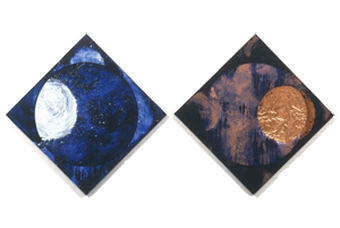 Now when she looks to the heavens, she sees stars.
Have mathematics and Minimalism ended up as natural science or mysticism? One could ask the same thing about lots of contemporary painting, caught between sensation and conceptual art. One thing, however, is certain. For Rockburne, a dedication to abstraction has become a dedication to color. Her "Astronomy Drawings" put painterly media through their changes. And her Homage to Colin Powell shows an artist still able to tackle the scale of a mural—and the time scale of natural history—or to recreate her Drawing Which Makes Itself from forty years before.
Two ideas of abstraction
Her signature work nearly excludes the human hand. In her Egyptian Paintings of around 1980, Dorothea Rockburne prepared the ground with chalk, glue, and gesso—and added nothing. Folded paper, canvas, or linen determines its own geometry, and only its shadow breaks with fields of white. Sometimes a penciled rectangle frames the overlapping triangles, as if she were calculating and measuring where they would fall. Her biography insists on her study of mathematics. In an interview accompanying a small show at the New York Studio School, she keeps coming back to her interest in a ratio called the golden section.
The "Astronomy Drawings" themselves, however, look like anything but a textbook. The brightest primaries, against the broadest fields of white, form clean curves like galaxies, but in broad daylight. Dry brushwork, in acrylic and other media, leaves individual points of color like stars. Darker paired diamonds might suggest a night sky for Emily Nelligan, but with uncanny bursts of light. Other works look like worlds in collision seen up close or within. Washes and drips obey or defy the laws of gravity, but here on planet earth.
Of course, art often overstates its basis in science. Realism long did, and new media still do now and again. Artists turn to nature for truth, but also for visions, metaphors, and traditions. Rockburne paid tribute to ancient natural histories this past summer, when she overlaid a constellation on that resplendent, near-abstract mural. The golden mean has more to do with classical proportions than higher mathematics anyway. And Rockburne has long earned the right to claim them as her own.
David Cohen, gallery director at the Studio School, notes similar tensions in the idea of abstraction. It "abstracts away" from reality to theory, or it returns to the sensory. By grounding art in its material essence, Clement Greenberg managed both, at least in his own mind, and Rockburne always has. She started with an art form closer to intuition, studying dance as a child. She worked at Black Mountain College alongside Robert Rauschenberg and John Cage, shared in the first "happening," and hung out with the Beats. Yet her early paintings long seemed like a progressive pursuit of rigor.
They also track their time. Born in Montreal in 1932, she settled easily into New York, give or take separation and divorce. She assisted Rauschenberg in his studio, when his combine paintings were treating painting as anything goes. Yet she and others started thinking again at the boundary between two and three dimensions. In the 1960s she interrupted a single color for only the white outline of a rectangle. By the 1970s color had gone, in favor of gritty assemblies that spilled over into surrounding space, like Robert Smithson in earth or Richard Serra.
Rockburne introduced the golden section soon after, a time of geometric abstraction for others as well. These paintings reintroduced oil, but in burnished tones and off-kilter shapes that still connect to Minimalism. They also mark her first admixture of ground metals. The Egyptian Paintings parallel shaped canvas by Frank Stella, David Novros, Charles Hinman, and Ellsworth Kelly, to name a few. All along, though, one can see the traces of the artist, much as for Kelly in his elusive plant drawings. The first rectangles quiver with the mark of a brush, the assemblages earn their grit with tar on paper, and the geometric series embrace gradations.
Night and day
They were long my idea of the artist. To turn to the "Astronomy Drawings" is like night and day. The drawings, from the early 1990s to the present, mark an explosion of color. It is a stretch even to call them drawings, just as it took chutzpah to call the Egyptian Paintings paintings. They include pretty much everything under the sun except oil, all identified meticulously by brand name. As ever, whether with intuition or geometry, Rockburne does not trust to chance.
Yet the drawings gain from surprise. The largest and most recent, with overlapping fields on the scale of Hans Hofmann in oil, are watercolors. The most watery, from 2006, are acrylics brushed or spilled over polyester. Imagery, too, draws on contrasts and paradox, as do titles like Wave and Particle. The paired diamonds from 2002 hold twin moons—one a white crescent of water-soluble acrylic on blue, the other of roughly textured copper. In Summer's Nighttime Sky of 1993, the horizon has the color of sunset, while the foreground has the color of night.
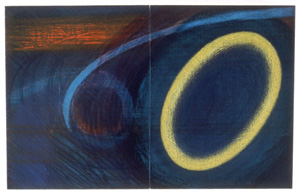 Actually, the explosion of color began with the "Astronomy Drawings," Rockburne at her most geometric. Series like Guardian Angel of 1982 added bright oils and watercolors to the folds of the Egyptian Paintings. I would make them the centerpiece of a retrospective, should a museum finally offer one. They may also help explain why she has never had one. They did not give people what they expected, about painting or about her. They were anything but delicate or austere, and they came just as others were rejecting abstraction for broken plates and appropriation.
A whole generation of women experienced something similar—always active and often exhibited, but still on the fringes. Women often peak later, too, while working and raising kids, which does not help. She had entered her fifties by the time of Guardian Angel, in an art scene that already valued youth. Feminism in art became overtly political, too. Painting, people started to say, was dead. They could have meant drawing.
One can see her painting as gendered anyway. Paper and transparent sheets stand in for Serra's molten lead and shredded rubber. The mix of metal and pigment in the Golden Section paintings also relate them to decorative arts. The white paintings allow the fabric to speak for itself, like a weaver or a dancer. Their shadowy folds may even evoke labia. The tension between intuition and deduction raises questions of identity and gender as well.
Rockburne's turn toward subjectivity and the cosmos predicts changes in art, too. Painting did not die after all, but narratives of its progress surely did. In "Drawing Connections" at the Morgan Library, she paired her work with Renaissance artists. And she chose not classicism but the Mannerism that followed, much as art today uneasily follows Modernism. Reasonable or not, Rockburne also takes her astrophysics seriously. If it has more to do with metaphors for spiritual crises, that, too, seems contemporary.
Homage to the Milky Way
The next summer, she looked explicitly to the past and the sky. So did my own visit to the World's Fair grounds, as a native New Yorker. However, her vision of history is deeper than mine. It has two scales, one personal and one cosmic. If that sounds pretentious, the artist does not treat a human life as a window onto eternity. Rather, she uses the stars to measure out a lifetime.
For Homage to Colin Powell, Rockburne works big. The painting measures forty feet tall. It also spans the Milky Way. Its broad white diagonal crosses a larger field of blue, representing the night sky at Powell's birth. At completion, the mural made its way to the American embassy in Jamaica, the birthplace of Powell's parents. By then, she had added the constellations, as well as a ram's head signifying one.
Artistically, the Queens Museum does not often think big, but it does worry about its place in the community. Its concurrent show of art about the Middle East, "Tarjama/Translation," pointed to New York's diversity, with a sizable Jamaican population. (Powell grew up in Harlem.) Along with its remarkable panorama of New York City, the museum has a relief map of the watershed. Another exhibition, by Damon Rich on the housing crisis, lay somewhere between art, education, and propaganda. Charmingly, a public museum charts the failure to rein in the private sector.
With Rockburne the local focus includes the work's making. Starting in early July, she was painting on-site, and it adds another layer of concrete personal history. (And here you thought that only Rirkrit Tiravanija, Carsten Höller, Tomás Saraceno, and "relational esthetics" treat a museum as an open studio.) On a Sunday in August, I could not see the artist at work. I could, though, see marks where she has taped canvas to the wall. Feathery brushstrokes filled out blue and white fields of color. 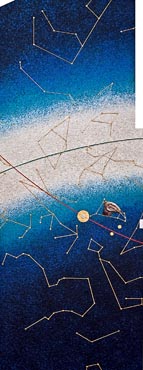
Rockburne again thinks rigorously but intuitively. Homage to Colin Powell makes me think right off of geometry, although in a tradition distinct from American abstraction—Josef Albers and Homage to the Square. She has appeared in "Color Chart," which even sounds like science lab. Does her folded work share the discipline of origami? Some recent paintings surround geometry with loose fields of color. Yet she still talks of them as manifolds.
As part of her temporary studio, she brought a bookshelf to Queens for reference. It included astronomy alongside a volume on the Mexican muralists. The tall painting may not turn mural painting on its head, but it does turn its dimensions sideways. A study next to it would make a large abstraction all by itself. I still look for folds and shadows within her colors. I worry that Powell's horoscope adds a fussier composition (or proves that Aries foretold war in Iraq). For a while, though, one could experience painting as ambitious, unadorned, anything but austere, and in the making.
Lending a hand
How can a drawing make itself? It helps to have Rockburne at hand to provide ever so much thought and care. Drawing Which Makes Itself turns to geometry and carbon paper, and each leaves its traces. The geometry only starts with the paper, its black rectangle anchoring each composition to the wall or floor. It extends to the gallery as well, as Rockburne positions a sheet in relation to the room. She presses in a line across the paper, then draws in black and colored pencil along its edges.
This was 1972 and 1973, when silkscreens and self-replicating geometry had taken over the joint. Arthur C. Danto had used Andy Warhol as a paradigm for meaning. Artists were quoting "The Work of Art in an Age of Mechanical Reproduction," by Walter Benjamin, and Rosalind E. Krauss was moving toward her own criticism of the "originality of the avant-garde." Grids were everywhere, and Krauss was to cite them as a reason to think of art outside of time, like a chemical reaction rather than a history. Rockburne's wall drawings also have a parallel in Sol LeWitt, with his strict rules for construction that become part of the work. Yet her carbons are hardly carbon copies.
LeWitt's colored ink for the 1988 Venice Biennale seems to depict massive sculpture. It also crosses thick black borders, as if the walls have become windows, and it brings out the texture of the walls, inspired by Renaissance frescoes. One just has to trust him that the planes do follow rules—and that the textures were there all along. Heck, he would have had the walls evened were they not regular enough. He also generally delegates his work to assistants, like the catalysts in Krauss's chemical reaction. Rockburne, in contrast, recovers the making of the work in time.
It allows her to think of art as a "locus of questioning." The questioning includes lines crossing every which way, a dispersal of the gallery's two and three dimensions in just one and two. It runs to folds, in larger sheets of white paper pinned to the wall. It also runs to vellum soon after—and to crude oil the year before, in 1971. She says that she was working on the cheap, but the materials give visual expression to opacity and translucency. As with Agnes Martin, drawing, color, and texture slowly detonate within a predominant black and white.
Rockburne's studies in art taught her to value drawing. Her studies in mathematics must have taught her a word for a result that makes itself, an algorithm. She called the crude oil on paper and board Scalar, after the Italian for ladder, but a scalar, too, is an entity in math—one with zero spatial dimensions, like a further concentration of paper, walls, and room. In 1974, she began her series based on the golden ratio, in which a small section is to a large section as the large is to the whole. MoMA also includes one of the Guardian Angels from 1982, in which the ground folds over itself. It concludes a show about its own limits with a burst of color and a step away from the wall.
LeWitt's work needs assistants because it could not possibly make itself. It depends on the contrast between conception and realization. Rockburne's drawing can make itself, but in collaboration. The carbon paper leaves accidental smudges, like unruly children, and she incises the lines, like an adult setting limits. One can think of the small show as a recreation in the present or a retrospective in miniature. Either way, she is there as the work creates itself, watching and lending a hand.

Dorothea Rockburne's "Astronomy Drawings" ran at the New York Studio School through May 1, 2010, "Homage to Colin Powell" at the Queens Museum of Art through September 16, 2009, and "Drawing Which Makes Itself" at the Museum of Modern Art through February 2, 2014. Sol LeWitt ran at Paula Cooper through October 12, 2013. A related review looks at early Dorothea Rockburne at Dia:Beacon.