|

|
|

|

|
All Done with Mirrors
John Haberin New York City
Eileen Quinlan, Antony Gormley, and Mark Sheinkman
People used to speak of art as a mirror of life. Sometimes, though, it looks more like smoke and mirrors. One photographer even titles her work that way. The series title Smoke and Mirrors belongs to Eileen Quinlan, but it could stand for any number of shows this fall. Let me make it the theme for a fall 2007 gallery tour.
For all their trickery, too, these artists mean it quite literally, as art's substance and subject matter. Quinlan uses both to create photographs, while Jeppe Hein scans surrounding space simply by spinning a mirror, and Antony Gormley invites one to walk right into a cloud. If any of this sounds like high-school science class, the wisps in paintings and photographs by Jaq Chartier, David Fried, and Mark Sheinkman might present illusion or just plain hard evidence. 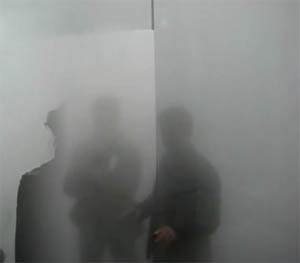
Spin and reflection
Plenty of cameras make use of mirrors along with lenses. The most powerful telescopes, called reflectors, use mirrors exclusively to collect the light. However, with Smoke and Mirrors, Eileen Quinlan alludes to objects in front of her camera. They include the crisp edges of a plane and the hazy shadows of dust, like the blackness surrounding horses and gardens for Sarah Jones. They include the transparency of an image caught in both, like the ghosts of abstraction past. Quinlan brings them, their reflections, and the camera's eye together.
Quinlan starts with a metaphor for deception or anxiety and makes it her subject matter. In "Strange Magic," a recent group show of women photographers, her triangles radiated out from a fixed point. They made me think of Mark Grotjahn and his tracks of color, as if vision had found its vanishing point. Their shimmer recalled a time when photography mimed abstraction in search of artistic respectability—or an even earlier spirit photography. As with Raha Raissnia, Willa Nasatir, or Mariah Robertson, photography now is more likely to look past objects for a sign system. With Quinlan, the signs look simple but do not easily add up.
Without the least digital manipulation, her prints from large negatives allow textures and patterns to overlay and to multiply. They also acquire warm colors and silken grays. Quinlan's broken symmetry may make her images less recognizable, but it allows her to take illusion seriously. Faced with her work, one had better. In a later series, based on floral arrangements for funerals, broad areas near the center of the image appear physically torn out of their frame. One can see it as an act of loss or recovery, where, she points out, Roland Barthes saw photograph albums as terminating in death.
The summer group show helped place her in context of other quirky women photographers and a show at MoMA once called "The Photographic Object." It obliged one to link her mirroring to a male gaze. A photo of hers concurrently at the Whitney at Altria gets lost behind a reflected ceiling. However, Quinlan is not just repeating either lecture on the social construction of reality—the museum institution or a woman's right to stare back. Rather she is observing reality and its illusions, like astronomers at their own reflectors, in gorgeous detail.
When artists think that they can blend art and science, they are usually right, just not in the way they think. Sure, they can take science for subject matter, inspiration, or knowledge of materials and techniques. In fact, they can hardly help it. They also necessarily share with science an exploration of reality, external or not. They can easily fool themselves, though, into mistaking the style of scientific illustration for a greater representational truth. If they do, they are not producing good science—or even good art.
Then again, who can resist trying? Everyone these days has to cope with the authority of science—and not just those working in new media. When Jaq Chartier uses inks, dyes, and chemicals, she seeks correspondences between doing science, the process of art, and the unfolding of an organism. Still, her "Color Tests" would not look so appealing without the rich colors of her water-soluble media. They would not look so spooky, either, if one could not imagine one's DNA as determining one's fate, whether genetically or in a future police state.
Sitting on a park bench
For a simpler science experiment or magic act, Jeppe Hein simply rotates a mirror before one's eyes—or rather two mirrors. Their planes thrust out above one's head, at right angles to one another, and each almost seventeen feet long. I first mistook the construction, set in the ceiling at SculptureCenter for three planes, until the changing scale, shape, and position of the apparent central panel made me think again. That gave me plenty of time to appreciate the wing-like art object and the warehouse space. By then, the mirror caught another visitor sitting nearby and brought us all back to earth.
One could dismiss Hein's Illusion as an oversized toy. One could ask whether "spin," as in politics, has taken over contemporary life. Hein echoes, however, machines that might once have hoisted factory materials in the same interior. In a sense he, too, reflects themes beyond art's illusions. Call it the social construction of art or art's reconstruction of society. Either way, it takes some comic turns along the way.
That theme becomes more explicit in the sculpture garden. There Hein, a Danish-born artist who works in London, imitates the familiar wood-slat bench of picnic tables, but with a few twists. One does a loop-the-loop in the middle, right where one might hope to sit. Another sags to the ground like a fabric ribbon. One turns its back on the viewer, with a closed circle for conversations that can never begin.
Another's back arcs forward, so that the bench itself has flipped right to the ground. Ironically, its underside functions quite well as a park bench. That may explain why Hein has sited that one in a nearby public space—two blocks away in Courthouse Square. Just beware of the shock of cold, white metal where one might expect warm, red wood.
Wondering what happened to the reflection of Quinlan or Hein in their own mirrors? Such reticence may hint at a taxonomy of artists. They seek total control of their art, or they trust to chance. They seek total control of the experience, or they trust the viewer. They seek the conceptual or the handmade—or conceptual art in abstraction. As Sara VanDerBeek reminds one, they ask photography to think of time.
Okay, I exaggerate. All artists fall somewhere in between on both counts. Besides, the further one pushes toward one extreme, the more one invokes the other. Robert Smithson had to haul plenty of earth before tides, climate, and entropy could let it rise and fall in the Great Salt Lake. Nor can one lay the axes at right angles, as if one could firmly distinguish art and experience. Still, they could allow some charming textbook graphs in two dimensions, and the next artist hogs the map.
A clouded glass
I had thought of Antony Gormley as a craftsman in his art, the kind who can draw in space with metal rods as fluidly and precisely as a great draftsman on paper. I also thought of Antony Gormley as fully in accord with Minimalism's surrender to the space and experience of the viewer. His fields become shifting but precisely defined planes or curves in space, then three-dimensional human beings. Yet if I had Gormley in the corner with art object and viewer, this time I no longer know where to place him. He lets steam fills a glass chamber at as it may. Meanwhile one can hardly move a humid step without feeling short of breath and in fear of falling, like the viewer let loose in the dark by David Hammons.
Has Gormley switched positions entirely, or did I have him in the wrong corner of my graph all along? Perhaps little has changed after all, even in a candidate for most dangerous exhibition of 2007. Nothing dissolves the art object into energy as completely as empty space, and nothing can so blind a viewer. Magicians always want control of their audience, and I had almost forgotten that moment of terror when about to run up against an empty cage seemingly holding a person. A title like Blind Light could suggest a work of art—or light itself—connecting with the viewer like a blind man with an elephant. It could mean instead a viewer as blinded by the light as a Bruce Springsteen fan.
One can still roam at will, if one dares, and instead of colliding with a humanoid monster, one collides with water vapor—or perhaps a dozen friends and strangers. Nor has he given up geometry: the glass enclosure runs parallel to the gallery's white cube, and one can take its measure by circulating the narrow space between walls. Other work in the show indeed reprises his cocoon-shaped metal grids that in their interior take on human form, leaving in doubt whether they stand for a chrysalis or a cage, conducting rods or an electric field. Then, too, he may have let on to his nature all along, as less an artist than a carnival barker. When this work appeared at the Hayward in London, not even signs warning of disorientation and a £15 admission fee could stem its popularity.
I wanted back Hammons's sense of play and Gormley's old formal control of point, line, plane, volume, and medium. On the one hand, something feels too akin to pure showmanship rather than to art or science, despite the half inch of forward visibility, as if to give new relevance to Michael Fried's infamous dismissal of Minimalism as theater. On the other hand, the cool, damp cloud feels more heavy handed, more desperate for grand statements about humanity and mortality. Chris Ofili and Damien Hirst share that uniquely British paradox. I looked up at the gallery lighting filtering through the steam like a James Turrell ceiling, wondering if I could or should feel it as a release and an incarnation, but the message from heaven or from within somehow refused to arrive. Or was that formalist refusal the message all along?
David Fried has his own reasons to care about the scientific method while letting off steam. When he makes filmy photograms of filmy soap bubbles, what Man Ray called rayographs, he crosses his medium with his message. He also evokes the origins of photography as a chemical process, as if art, like a soap bubble, could find its own natural shape. The results look crisper than one might expect, no doubt because not soap but light alone makes contact with his sheets. Curiously enough, they look more painterly as well. I mistook the highlights for brushwork.
Soap film sounds too well scrubbed, but Fried looks best when his art most resembles a science experiment. Balls of light wood glide across tables, bumping into themselves and the surrounding ropes, like boxers too confident to know when to quit. The sculpture risks devolving into still another classy toy, but with a palpable mystery. What does keep them going, and where does he hide the motor? In reality, they draw their motive force from the vibrations in the room itself, including footsteps and ambient sound. Art, they seem to say, differs from experiment in pressing onward when the observer's back is turned.
Kinds of film
Mark Sheinkman's work, too, might pass for a parlor trick, a science experiment, or photography. He is just painting, though, honest. He combines alkyd, oil, and graphite in white on deep black. The swirls create tonal variations from precision to ghostliness. One sees the painting as translucent but not colorless. One sees it alternately as film, as pencil shading, and as a slab of oil.
Sheinkman recalls the layered tracery of Abstract Expressionism, the shallow space of Brice Marden, and hints of calligraphy. He also lets go of drawing in the sense of defined color fields, mappings, or formal symmetry. As bands of white cross a black ground, they threaten at any moment to dissolve. Like magnetic field lines, the curves never appear to cross, but the depicted space accommodates them all just fine. While earlier works maintain a dense weave, increasingly the white gathers into a few thick, bright cords.
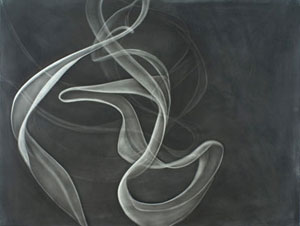 Squiggles thrive all the time in abstract painting, of course. Think not just of Abstract Expressionism but also of Sol LeWitt pencil drawings on bare walls. In the 1990s Sheinkman even painted in the form of oversized scrolls, with the writing reduced to ashes. Much of that literalness is passing, along with the busier, fussier compositions. At the same time, the highly controlled tracery makes one more aware of his material's fragile complexity.
Maybe painting no longer fits my usual lectures on abstraction, flatness, and the cutting edge. Even Jackson Pollock, though, did not so much stick it to painting's surface as create an illusion. I mean the illusion of shallow depth, enough to hold the paint. Only through that illusion could art hope to signify the painted surface itself as object. Pollock's weave feels sometimes like an obstacle, sometimes like inexhaustibly deep space. Sheinkman plays with paint's literal shallowness.
He remains a conservative at heart, and I relate to that. As with David Reed, translucency gives the illusion of brushstrokes, without giving up on formalism. One can see the graphite powder as modeling the white curves in three dimensions. To Reed, the "painterly" relates equally to geometric abstraction and the Baroque. I suspect Sheinkman would agree.
Reed also gives the illusion of film strips. The shiny black alkyd here, too, suggests a photographic negative. Sheinkman may be growing more personal, then, but he may also be hinting at less high-brow processes of reproduction. One can think of the blending and smearing as a form of self-erasure, as with Pop Art silkscreens. Or he may have decided that to carry on with painting after all these years, one had better accept it as an experiment.
Eileen Quinlan ran at Miguel Abreu through December 9, 2007, and again through April 29, 2010. Jaq Chartier ran at Schroeder Romero through November 24, 2007, Jeppe Hein at SculptureCenter through November 25, Antony Gormley at Sean Kelly through December 1, David Fried at Sara Tecchia through October 20, and Mark Sheinkman at Von Lintel through November 24. I have also integrated notes about Sheinkman's shows at the same gallery through April 14, 2004, through March 25, 2006, and through November 14, 2009.