|
|
|

|

|
Starting Over: After Art History
John Haberin New York City
Arthur C. Danto: The Madonna of the Future
Arthur C. Danto did not redefine art, and he did not reinvent art history. His obituary in The Times ran late, and it vanished online almost as soon it ran. To judge by social media, his death was far overshadowed by that of Lou Reed even among artists. And yet his influence was immeasurable.
All that is to say only that he was a philosopher—the most noted and noteworthy philosopher of art of his time. Where the privilege of artists and critics, now and then, is to change the rules of the game, all a philosopher can do is to change the conversation. And no one did it better than Danto, who died October 25, 2013, at age eighty-nine. What follows is a book review from 2000 tried to pin him down. A briefer obituary follows as a postscript, and if that entails repetition here, so be it. 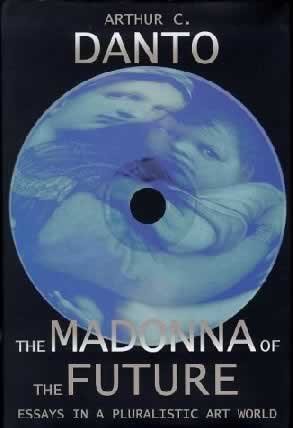
Arthur C. Danto's lively essays from The Nation. . . . No, no, no, start again. Please.
When a major philosopher turns art critic, expect. . . . Now, wait a minute. I am talking about Danto here. I must have learned something, after more than fifty quirky, thoughtful, and inspiring reviews of the art scene. Never, ever start with the real subject. Make the reader connect. One more time. Ah, there we go. . . .
Immanuel Kant had a problem with art—a big problem. He could hardly bear to look at it, and he preferred it that way, too. Painting, he explained, stands as the highest art form because one can turn one's back on it.
Reaching the ground floor
Kant did like turning his back on art. Music, for him, resembles someone's getting on an elevator wearing too much perfume. No wonder one can make it through Critique of Judgment with nary a work in sight. His elevator doors never shut, so that art may rest in its penthouse studio for eternity.
Naturally his nearly five hundred pages contain examples—but not paintings. I spotted a flower and the Milky Way, and I vaguely recall that Kant admired Lacoön, although I cannot swear that his admiration made it into the book. Still, sculpture here means "statues of human beings, gods, animals, and so on," safely in the plural. He sounds desperate to get through them all. Art, you see, deals with ideas.
Thought itself, for Kant, depends on ideas that have no basis in experience—time, space, God's purpose in nature, lofty stuff. Art has plenty of ideas, but no dirty hands. (He should visit the modern museum with a donor in tow.) With no purpose apart from its being, art goes right to the foundations of thought and nature.
Morality begins with a similar leap, from mundane ends and nasty constraints to human freedom. No wonder esthetics, in Kant's eyes, leads to a broader critique of judgment. When it comes to gallery-hopping, cultivate your taste. Forget description, and head for the bottom line.
Of course, I made up the reference to an elevator, though really only to embellish his metaphor. I had something else in mind, too, by the historical lapse. Suppose I bring Kant forcibly into the present. I want to assign this famously difficult writer to reviews. Let him encounter real art and artists, in accounts aimed at the ordinary public. Given his politics, rather far from The Nation's, he could at last retire a neocon like Hilton Kramer from The New York Observer, a welcome side benefit. Talk about an anachronism.
Besides, Kant took exactly the same walk at the very same time each day. One could set one's clock by him, like a yuppie who gets in his swim before each workday. Starting from my place, he could end on a walk in Chelsea. What would he find? And would anyone understand a word of it? I suspect that I have already mangled his philosophy pretty badly.
The open hand
If Kant had the clarity of Arthur Danto, they would understand every word and find riches. Back up again, and reconsider my beginnings. Was I elevating Danto to the ranks of dead white male philosophers, or gently making fun of their higher realm? Well, yes. I have particularly in mind a provocative mannerism in his style.
Danto's reviews appeared in a weekly magazine, always in time to influence museum-goers. Yet they never start with Kant's bottom line. In fact, they rarely start with the artist at all. A review of Robert Ryman begins with yet another Robert, Rauschenberg. Nietzsche introduces John Heartfield, Wittgenstein raises questions about Robert Morris, Kenneth Clarke on the nude unveils Lucian Freud's nakedness, and Clement Greenberg's critical legacy gets a rundown before a show of Pop Art. And the book has hardly gotten off the ground.
Some connections seem obvious, at least in retrospect. They give the outstanding issues in art history a moment to settle down before art unsettles them yet again. Others have the shock of a fable. After all the hoopla over "Sensation," a show supposedly unfit for children, he suggests seeing the young British artists through the eyes of a child.
The device suggests Danto's greatest strengths. For one, he draws connections—between artists, between artists and ideas. Maybe he cannot reverse Kant's course, to proceed from ideas to lived experience. But at least he can start with the "wrong" experience, like another philosopher turned critic in Stanley Cavell, and he can make those dead philosophers a matter of pressing urgency. I often wished that he omitted a review's title, to challenge me further.
For another, he takes the time to reflect. One opening mini-essay suggests how perspective space for Salvador Dalí became instantly recognizable—not as the skilled illusion of reality, but as the stuff of nightmares. When Danto visits Cy Twombly, he sees how gestural art creates the equivalent of a novel's narrator, a fiction that Danto calls the artist's "implicit hand." These openings remind me how far a good critic's implicit hand can stretch—and how open it must be.
For yet another, he cannot stop talking about art, whatever the topic at hand. I made fun of the conversion from academic to journalist. However, for Danto, New York's galleries never required a detour. Andy Warhol himself triggered the Columbia professor's philosophy of art. When he tells of sitting three times through Shirin Neshat's Rapture well before it reached a Whitney Biennial, I hear the same gallery fan for whom Brillo boxes amounted to a conversion experience decades ago. And then he describes her full video and where it led him.
Deducing art
An essay's opening amounts to merely a rhetorical device. Still, it thus reveals much about a writer's way with words. I looked forward to the one-liners that often round off the excursions. That "implicit hand" of Twombly's becomes "a kind of memorial to graphic ineptitude." I must thank The Nation for giving a critic ample space to talk art through—to describe its appearance, to probe its associations, and to admit when its questions exceed any one viewer's answers.
On the other hand, the openings hint at what can go wrong. They even give insight into what bothers me about his philosophy of art. As a scholar, Danto puzzles over what he calls indiscernibles, particularly works of art no different in appearance from "ordinary things."
What makes Warhol's Brillo boxes art, but not the ones in supermarkets, and what distinguishes a copy by Sturtevant from a Warhol? How does house paint, bare canvas, your whims, or just a fake differ from abstract painting? For that matter, how do austere monochromes come to differ in meaning? Adopting an exhibit title right out of Kant, "Making Choices," the Museum of Modern Art sets out a room of one-color paintings. The artists range from Yves Klein, who applied his single, flat shade of blue indiscriminately, to Ryman, who nurtured the materials of paint and its support. What allows Klein to dismiss offhand any idea of art as unique product, while Ryman torments it into life?
Art, Danto concludes, cannot depend for its being on visual qualities, much less the skill in representation prized in Kant's time. It even exceeds the say-so of the art world. What art can do is create meanings. I need not discuss yet again Danto's, in my mind, painfully simple scheme of ordinary things and art's meanings. No one wants to hear me try. Consider, however, how he embodies some key assumptions in those openings.
Danto emerged from the Anglo-American tradition of analytic philosophy, which aims to replace philosophical jargon with logic and idiomatic English. Sometimes that leads to nasty fights. From the other's perspective, either of the two standards can start to seem an escape from reality. But both sides agree on something: they associate clear thinking with getting results. That same clarity extends to Danto's reviews aimed a larger public.
Both sides agree, too, on a curiously deductive approach. No wonder Danto likes to prepare readers before they examine a work. No wonder, too, that so many reviews begin not with artists at all, but with philosophers.
Dancing around philosophy
Philosophy's split with the public predates late-twentieth-century academic specialization. It has also haunted philosophy. Stylists such as Thomas Jefferson or Karl Marx may have made revolutions. Today they dance around the margins of philosophy departments, as Friedrich Nietzsche did not so long ago. But then Nietzsche could "only believe in a god who can dance."
Art's status within philosophy makes the dance stranger yet. It comes off as a mere frill, compared to the study of knowledge and ethics. At the same time, an addition has a way of taking over the joint, with what Jacques Derrida has called "the logic of the supplement." Plato, who banished poetry from the world of ideas, has his speakers lovingly recite it aloud. But then his dialogues are literature. Meanwhile, for all the intellectual vitality of Deconstruction, Michel Foucault, or the Frankfurt School of Marxism, students have long headed over to literature, art, and music departments to study them.
Against this dance, Danto, Nelson Goodman, and W. J. T. Mitchell, to name a few, have had a splendid commitment to the philosophy of art and to writing well. They bring on new respect, too, for great art historians of the past, thanks to their breadth of learning and uncanny ways with seeing. Iconology, Mitchell's title, suggests his debt to E. H. Gombrich and Erwin Panofsky. Danto has a moving reminiscence of Meyer Schapiro's lectures.
Even so, only Danto became a weekly critic—although he did it in yet another supplement, his retirement. No wonder the dance between philosophy and criticism enters his argument quite as much as abstract art and Andy Warhol.
I called the openings fables. I could have said hypotheses, and Danto has too often invoked what I have called hypothetical art. When he imagines a row of squares, one can hardly question his right to define their appearance once and for all, to assign them meanings or non-meaning, or to call some art. But when he does so, he is then talking apart from any possible experience, not to mention in circles. Perhaps he shares more with Kant than he would like after all.
Some of that unsettling bias creeps into Danto's weekly reviews. He repeats examples from his scholarship, such as Kierkegaard's imagined monochrome, red canvas of the Pharaoh's armies, drowned in the Red Sea. He praises Greenberg for criticism as "thought experiments." He imagines Bertrand Russell's art criticism, probably no better than Kant's. His very title, The Madonna of the Future, refers to art as a fiction, in a story by Henry James.
Too much of the same thing
Danto sees his indiscernibles everywhere, and that is literally too much of the same thing. When he does not, it bothers him. Did Andy Warhol start off with loosely painted Pop anthems or with Warhol's faith? Danto calls the gesture "mere superstitiousness and aesthetic conformity." To me, that gorgeous phrase captures instead Warhol's lifelong love-hate relationship with fine art and mass culture. It thrills me, and it refuses to leave things as "ordinary" as advertising quite so meaningless.
Similarly, Danto finds himself drawn to Jasper Johns for his "reverse ready-mades." Although beautiful objects, he notes, the targets dare one to shoot at them, like found objects. True, but here Danto overlook much of the painting's impact on the viewer, who stands discomfortingly and alluringly at point-blank range. Masaccio's Trinity, the first great example of perspective, springs perfectly to life from precisely six and one-half feet away, and one has to kneel, too. In 1400, God walked on earth, and he could fairly insist that one bend to acknowledge the unprecedented event. Jasper Johns disturbs a viewer's relationship to the work and to illusion, with an unfair demand.
Just as his interpretations keep coming back to the same point, so the choice of artist has a way of returning to the same decade. Danto misses too much current art and too many retrospectives of art's history. After his reviews of "Sensation" and Nashat, or his noticing Jan Vermeer's trickery with mirrors, I had to wish that he pushed himself more.
He also remains uncomfortable stepping outside art in search of vision—and into society, history, psychology, or biology. The openings give art a context, but not in the sense of much recent criticism. At one point he tracks a chain of causes, from artist to cultural movements, but after that, "I don't know." Criticism turns itself into a reverse ready-made of its own, drawing back from life.
A brilliant epilogue gets to a puzzle in his philosophy. Does Danto intend the existential condition of all past art? Or does he mean to penetrate a fragmented art world of abstraction and appropriation? He argues, if I follow him correctly, that his definition has always applied to art. However, only Warhol made the condition of art an explicit part of its meaning. He thus brought on the end of art's history.
Danto could all but have anticipated Postmodernism, by finding a break between Abstract Expressionism and chaos, a chaos that values appropriation and pop culture. Yet he remains paradoxically the high modernist. He uses the break to resurrect art's sense of progress toward a final goal, quite as much as had Greenberg. And that final goal allows fine art to remain clear and distinct, a value entirely to itself. Commerce and decoration go into the bin with ordinary things. No wonder the reviews seem so reluctant to face art since Johns and Warhol.
Imagine that
I worry that Danto has it both ways with past and present art, thanks to a desiccated concept of "history." It cannot connect trends such as "diversity" to conditions outside art—conditions that have a way of changing or starting over, after one thinks the story has ended. Hegel predicted the end of art history two centuries ago, and here philosophy goes again. Perhaps neo-appropriation art now, like neo-Warhol in the 1980s or Warhol's neo-Dada, itself defines an age of nostalgia, an age indeed dedicated to history. A critic ought to illuminate it—in all its specificity—while knowing how much else escapes.
In other words, for all their openness and freedom from ideology, the reviews are always pressing a case. Talk about Kant's "purposiveness without purpose." I can hardly complain, for no one critic can do everything. Few even begin to do much of anything, and none does what Danto can do. He helped me search for a space between judgment and academia, criticism and philosophy, a place of surprise understandings.
Danto's point of view does, however, make for a long volume on just the years 1993 to 2000. Some one-liners and certainly Russell turn up once too often for my, er, taste. So, as I say, does the alleged historical moment at the end of history.
Danto deserves every word. Schapiro scrupulously prepared his papers, leaving me disappointed when a volume omitted something that I had treasured in memory. Still, I hope Danto's publisher releases a book one day with selections from all his criticism. He deserves the wider audience that could garner, too.
A philosopher's essays, I learned, can enter the trenches along with me, as they did back in the centuries before Kant. Oh, and that reminds me, I left Kant in the lurch. You know, I think he could have started to enjoy the job. Imagine that!
Kant might have loved how Jackson Pollock, Mark Rothko, and others latched onto an idea dear to his heart, the sublime. Appalled at how they altered it, he could have offered insight into how they put human constructions at the center of nature. On the other hand, he might have found himself something of a postmodernist. Here he was, sharing in the critique of Abstract Expressionism, from Minimalism to feminism. Or he might have judged scale entirely differently than he had before. He might even have discovered an experience not found in Lacoön, Saint Peter's, or the Milky Way.
Sensational philosophy
Kant could naturally have improved on my elevator analogy. Try boom boxes on the subway, for instance. From there, he would have only a short detour to video—as music video or museum installation. I hear him dismissing Bill Viola's surround sound. He might have seen well before I myself did how Gary Hill's videos—or Nashat's—take ideas more seriously and more wittily. Yet he might have expanded his mind again, finding himself not quite so ready to turn his eyes from their disturbance of the sensual.
Kant could have gone to town with Marcel Duchamp's Fountain. If art displays "purposiveness without purpose," the urinal defeats at least one male purpose. And yet it takes on his notion of purpose—for things or for art. Should Kant now call his former walks, stripped of the purpose of visiting galleries, a work of performance art?
Duchamp and his legacy, from Rauschenberg combines to appropriation, also challenge Kant's tidy little list of sculptural themes. Art in this century, he might admit, lives in the uncertainty of the "and so on." It unsettles any ranking of the fine arts. Indeed, it sits strangely with the whole emphasis on "judgment."
He might actually have liked that, too. Sticking to his guns about esthetics, he could have proclaimed the end of art. I see him gratified by the chaos of survey after survey, tactfully named "diversity" these days. The philosopher of the limits of sensation could take a perverse delight in the name "Sensation."
He and Danto might end up liking each other a great deal. Here at the end of art history, the idealist and the pragmatic art lover could chair a panel together. I sure would show up.
In short, a philosopher cannot—and need not—abandon a thesis, but encounters with art have a nice way of transforming hypotheses into life. Imaginary art can never become real, but all art throws life into the workings of the imagination. Critics and philosophers share the priceless job of looking for it there.
A postscript: in memoriam
To return to an obituary in 2013, philosophers may change only the conversation, not the rules of the game, but Danto's own game changer was of course Andy Warhol. In memoriam, let me say more, with links to his meaning for my criticism.
If Warhol's Brillo boxes of painted plywood are indiscernible from the real thing, what makes only one of the two art? More crucial still, what does that say about art? As Danto outlined in a 1964 essay, "The Artworld," and at greater length in The Transfiguration of the Commonplace, only one has meaning rather than a utilitarian, predetermined function. Because it is in the gallery, one looks at it as art. And both it and the viewer will never be the same.
Danto certainly was never the same, and that, too, sets him apart. For one thing, it sets him apart from more popular and conservative writers, like Robert Hughes, for whom Warhol was the beginning of the end. To Danto, Warhol was only the beginning of a more aware and more pluralistic art world. If anything can be art, who is to stop artists? He presaged and celebrated contemporary art's dilemmas and potential, in breaking boundaries between media and genres, while also having to do without an avant-garde or a definition beyond what sells. For another thing, he was that rarity—a practicing critic as well as a philosopher, with a column in The Nation.
Danto inspired the institutional theory of art: art is whatever museums and galleries choose to display. That can sound implausible, between public spaces and collectives, for who is to say what counts as an institution, and who is to say what in an institution counts as art? There is added irony in that Danto's death came during Banksy's much hyped stay in New York, with no one but he, his fans, and his Web site to answer for his reputation. That theory, though, belongs to another philosopher, George Dickie. Danto does oblige one to ask what art is, but he cared more for the how—how art works and how one can better understand it.
It also made him one of my guiding lights, in hoping to make art accessible and observation essential while not disdaining "theory." Even as a philosopher, Danto spoke in everyday language and with vivid examples, which helped make him so influential. So does his constant questioning. Rather than a new and fuller appreciation on my part, then, let me link to past efforts over twenty years now, some of which really got this Web magazine going.
First, I review (on this very page) a book of Danto's articles from The Nation. It is not his only or latest collection of reviews, but it should get you going. There I try to give a fuller account of his thought and career. Art after him may look oddly like life, but it also will never look the same. (Oddly enough, too, I recently took note of a spate of riffs on trompe l'oeil in both painting and photography.)
Second, I try to evaluate Danto's success. Rosalind E. Krauss found Modernism making copies all along, and that made her distrust the "originality of the avant-garde." In a review, I compare Danto with another leading philosopher of art, Nelson Goodman, whose Languages of Art cast doubt on whether artworks can ever be indiscernible from one another or from anything else, at least unless fails to look carefully or one wants them to be so. I describe Danto and Goodman as two sides of the impulse behind modern and contemporary art—to understand and to see.
Third, I play philosopher myself, in taking apart one of Danto's strategies. At crucial points, he introduces hypothetical works of art as thought experiments. Who, though, is to say whether they could ever exist, and who is to say what would really happen if one encountered them? I conclude that breakthroughs in art often start with a "what if?" And they were breakthroughs because the answers are so hard to anticipate even now.
Last, I turn to other critics, including one of Danto's former students at Columbia University, Barbara E. Savedoff. As her title puts it, when new work changes the nature of art, it is not just changing meaning, but Transforming Images. Her fine book locates ambiguity between realism and betrayal. Elsewhere, too, I often ask whether his Brillo could ever fool the eye. And I review another critic, Joseph Mascheck, who sure has his doubts. Enjoy!

Arthur C. Danto's The Madonna of the Future: Essays in a Pluralistic Art World was published in 2000 by Farrar, Straus and Giroux. The essays first appeared starting in 1993, mostly in The Nation.