|

|
|

|

|
Out of Fashion
John Haberin New York City
Dieter Roth and Lee Lozano
The union of the Museum of Modern Art and P.S. 1 has done wonders for art and New York City. It helps keep alive an adventurous, essential space for contemporary art—and I definitely do not mean MoMA. It adds to the cultural boom and still untapped potential of Long Island City. It makes one wish that the Modern's temporary home, MoMA QNS, would last forever, rather than give way to a gala Manhattan reopening in the fall. But has it really altered business as usual for either one?
This spring, for once, the institutions fully collaborate. Dieter Roth gets enough space for even his obsessive habits and outsized ego. His retrospective builds from his Bauhaus roots at the Modern to a full-blown tool shop at P.S. 1. Where the two museums go there own way, however, may say more still. 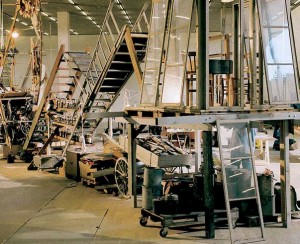
Meanwhile, Roth shares a wing at P.S. 1 with a woman whose ego was clearly not made to last. Lee Lozano has the temerity to make her signature paintings out of Roth's own favorite male domain, the tool shed. Yet her sadly neglected works dwell on her self-doubt, and she dropped art all but unnoticed in 1971, the year she lost her Soho studio. She had lasted barely ten years. Together, the three shows say a lot about the two institutions and about how women fare in a competitive art world. A postscript fills out Lozano's story with a focus on her tools and their silence.
From closet space to storage space
For now, if not for long, MoMA and P.S. 1 pretty much go their own way, but with the specter of the latter's conversion to MoMA PS1 on the horizon. With the Modern in Queens for now, an easy walk from its partner, one might expect more. P.S. 1, I could argue, has even let the older museum off the hook. Now it can act virtuous while leaving real experiment to others. It can safely represent Modernism and Postmodernism as a distant past. Sound suspect? It might work, too.
Modernism entered the textbooks fair and square. Like every inch of art and history, it deserves space for people to see it and to debate who owns it. Postmodernism loves institutions, too, if only to scrutinize them. In addition, while scrapped for space, the Modern has to keep its aims modest. Perhaps it can try more next year, with a monster in Manhattan and unclear plans for the building in Queens. Besides, who could conceivably do more for art than to leave Alanna Heiss, the director of P.S. 1, to her own devices?
That said, Dieter Roth makes a great case for bringing the two together. His overbearing, if not exactly overwhelming retrospective does not just cover them both. It puts the strengths of each one to good use.
The tidy spaces and movable walls of MoMA QNS give a born collector all the closet space he needs. It places him in European art history, from prewar design to something like Alighiero Boetti with a German accent. It caps his fifty-year career with a quilt and a wall-like contraption teetering, appropriately, just off the museum's awkward, sloping lobby.
P.S. 1 rounds out the show both in time and in space. It reminds one that Roth keeps at it while remaining largely an outsider to the New York scene. It also carries him from closet space to storage space. One long room offers a cross between a junk yard, a hardware store, and a roller coaster. Another stacks well over one hundred TV sets, perhaps even more than Jon Kessler can muster.
Unfortunately, it adds up to a little too much—and far too little. On the one hand, Roth will try anything, so long as it has his name all over it. On the other hand, he runs to a safe rehash. He recycles art movements that had long lost their momentum. He revisits work of his own that had too little motivation in the first place. He does not grope with the implications of recycling, in terms of art's authenticity or the urban sprawl of the real world echoed so well by, say, Phoebe Washburn.
From Bauhaus to outhouse
Roth fled to Switzerland in 1943, to escape Allied bombing, and his earliest work has neutrality written all over it. The first room holds student reworkings of Bauhaus motifs already grown quaint. From there, he tries printed books churned into sausage meat and rickety relief sculpture in kaleidoscope patterns. Even when he gets messy, he is articulating the proper principles of visual design, reproductive technology, and optical theory.
Roth at last makes his critical career shift, from neatly layered junk to junk for its own sake, with food. A cabinet of brown powder could stand for geological strata or human remains, but he is recalling the homey echoes of a spice cabinet. He also starts fashioning art of chocolate, including busts of himself. One should not approach this retrospective on an empty stomach or a full one.
For a while, his career loses any arc at all. He tries other modes of self-portraiture, from mod 1960s' design to videotape. He collects books of never-discarded sketches and carousels of slides from his years in Iceland. He presses trash into boxes and sorts them as if for a library. He seems like a guy who would try anything for a laugh, if only he were funnier.
The reflection upon self-reflection gives this art its punch. It takes a postmodern critique of art as expression and signs it in bold letters. It takes the concern for entropy of earthworks and removes any trace of the natural. If the final, huge pieces at P.S. 1 took years to accumulate, they grow out of what he has always done. Guess whose image one sees on those TV monitors?
Still, the show's haphazard course keeps it from ever having much urgency. Even the roller coaster amounts to a student copy of Liubov Popova's 1922 Moscow theater sets. In another's hands, the food imagery could point to shortages in postwar Germany or the strain of consumer culture. Here it looks isolated from much of anything, like a Godiva shop that happens to have sat around for forty years. Roth may never escape from his own time warp either, not even with his death in 1998.
As with the chocolate molds, Roth prefers ashen tones. He may grow slovenly and self-obsessed. Still, one never forgets that one is seeing a balding, portly German who passed his formative years, after Switzerland, in the chill of northern Europe.
Turn on, tune in, drop out
Roth's machine shop happened to share the MoMA empire with "Fashioning Fiction," a show including Cindy Sherman. Surely he and fashion photography belong together, much like Irving Penn and Madame d'Ora. They all know where to assign the sexes. Both know that real men and women never give up center stage. They make Lee Lozano seem unintelligible. Like others between 1961 and 1971, she turned on, tuned in, and dropped out. No wonder she also pretty much dropped off the radar for the rest of her life.
 Lozano did everything wrong. She dabbled in Pop Art, abstraction, and conceptual art, without sticking to anything long. She includes jokes. Long before the art world had assumed today's epic proportions, she challenged its politics with a Dropout Piece. And then she dropped out for real. She had the guts to compete with others on their own ground, plus the honesty to admit her frailty and her doubts.
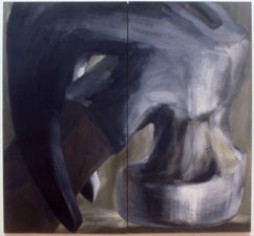
Lozano's best work, which P.S. 1 dates to around 1969 but most narratives place between 1963 and 1964, comes with a hammer blow. In fact, it depicts a hammer, in close up. The clarity of drawing, like the subject matter, suggests the Pop Art of those days, not to mention the assault on male posturing. However, the oil paint has a creaminess well beyond even Wayne Thiebaud in Thiebaud drawings and his layer cakes. The point of view makes it closer still to abstraction, as well as removing any chance that one can picture the tool in one's hand, as advertising product or as extension of the male ego. Lozano is happily losing her grip.
If one has a hammer, people say, everything looks like a nail, but she has little like it again. P.S. 1's two-story basement room has a way of making art look good—whether one looks down from the first floor, as if into a forbidden chamber, or steps up from below into the light. The abstract paintings hung there do look rather nice, even if I could not get over the sense that I had seen the pale tones and even curves before. Still, I may never see Robert Mangold as quite so original again.
Most of the other rooms contain works on paper, blending quick sketches and intricate annotations. Despite the great number and the detail, they go quickly, and they fill out the story of a woman trying to make sense of her life and her art. They also show a politically aware women trying to take the issues and constraints of her time seriously. They may not replace the hammer, but at least they make its luxuriant assertiveness all the more remarkable.
One sketch supplies a life in miniature, as an ironic résumé. It has the dates of a marriage and an abortion a year before. It dates sex, alcohol, and drugs as "continuing." The mix of wit and poignancy made me think again of Roth and fashion. She could not turn her art into a factory product or herself into an image for sale, but what happened then? Seven years later, a gallery suggests an answer.
Postscript: if I had a hammer
For Lozano, art was an act of defiance. So, for that matter, was not making art. She began her Dropout Piece at age forty—the very year her work appeared at the Whitney—and, unfortunately for her admirers, executed it perfectly. To their relief, a gallery offers at last an entire show of her tool paintings, and it is a revelation. Even those who know her painting of a hammer will marvel at how much she packed into a year. If an artist is only as good as her tools, she was very good.
Smart enough to have graduated the University of Chicago, she must have relished not making art as a work of art. In place of the enigma and Romanticism of Rimbaud's abandonment of poetry at age nineteen, she brought the same hard clarity as in her imagery. She must have relished, too, finally eradicating the border between her life and her art. She had already shifted to conceptual art and defiance—by tossing around copies of Artforum as her Throw-Up Piece and by listening to the radio during a panel discussion as her Transistor Radio Piece. As if to prove that she could compete with men even in defying the art scene, John Baldessari chose the same year for his video performance I Am Making Art. As for women, she preferred to ignore them entirely, in a conceptual work that continued to her death from cervical cancer in 1999.
The denial of feminist solidarity fits with the competitiveness and anxiety beneath Lozano's smooth execution and sense of humor. Her résumé includes her abortion, divorce after a four-year marriage, and drugs. Born Lenore Knaster in New Jersey, she started calling herself Lee at age fourteen and signing her name as simply E. Unlike another Lenore turned Lee of Eastern European ancestry, Lee Krasner, she could not help confusing self-assertion and annihilation. More than once, a wrench grips a razor blade. As Robert Lowell wrote, "each of us holds a locked razor."
When I saw the hammer in 2004 at P.S. 1, I could appreciate the tension, but not the range of her ambition. I could see her fluid brushwork as an appetite for ordinary things, like dessert for Thiebaud. It makes sense that the hammer's claws curve back to nestle around the hammer itself, as if caught up in the flow of paint and as if paint had a mind of its own. Lush need not mean thick either, a good lesson for Bay Area abstraction. It can even appear almost monochrome, with a healthy dose of black. Each area of color packs a wallop.
If Abstract Expressionism had privileged gesture and action, she had that, and if Pop Art had made paintings like posters, she had that, too—even while mocking them both. The hammer should make one think of Roy Lichtenstein when he painted WHAAM!, and the messy red strokes of her drawings compete just fine with Claes Oldenburg. If Minimalism made art out of industrial materials, she had the tools to assemble them, and if it demanded art as object, she painted the very objects. They just happen to undermine formalism, with realism and with compositions crossing multiple panels. Later abstract paintings of waves make the parallels and divergence explicit, but they also meant turning her back on her own imagery. Like the claw, her art and life turn back on themselves.
Not just the claw represents fantasy and overkill. Another hammer has three heads. Its unheard pounding looks ahead to her coming silence. One can see the tools as cartoons of the self, as with Philip Guston. One can also see Guston's self-portrayal as a fiction and Lozano's invisibility as a self-portrait. She refused to speak with or even refer to women, she claimed, as a step toward improving communication. That left nearly thirty years of a failure to communicate.

"Roth Time: A Dieter Roth Retrospective" ran at MoMA QNS and P.S. 1 through June 7, 2004, and "Lee Lozano: Drawn from Life" ran at P.S. 1. through September 13. Lozano's tool paintings ran at Hauser & Wirth February 19, 2011.