|
|
|

|

|
Who Knew?
John Haberin New York City
Family Pictures and Closed Circuit
Who knew? The question could serve as the theme of many an exhibition, but also as a statement about a museum. Who knew that a Frenchman in Antarctica could make American art, and what does that say about the Whitney? Who knew that one could call shit art (and vice versa), and where else if not in Brooklyn? Who knew that the Guggenheim and the Met still care to collect contemporary art, including new media?
With "Family Pictures," the Guggenheim insists on its continued commitment to new acquisitions. It also raises a hot-button issue—photography's threat to show more about human flesh and human relationships than one may wish to see. 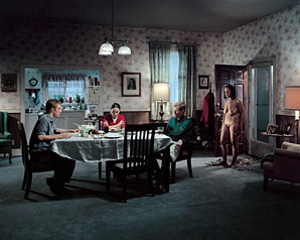
With "Closed Circuit," just eight video artists in the Met's permanent collection have the small rooms in the modern wing, at either end of the mezzanine. In the end, neither museum may look quite so contemporary after all, but for once they give it a try.
All happy families
When it comes to happy families, artists have generally sided with Tolstoy and looked elsewhere. Even the Holy Family has its dark side, with Joseph in shadows and a virgin doomed to mourn over her son's body. This unhappy family is clearly different in its own way.
In its recent acquisitions, the Guggenheim hesitates to choose sides. Part of it wants to assert its credentials, including a commitment to new artists and new media. And part wants to keep pandering, in the same spirit that fills the rotunda with Spain's "Time, Truth, and History." With "Family Pictures," one might expect images as alike as greeting cards. Ironically, the small show does a fine job of conveying a very different kind of uniformity—the numbing, often deliberately misleading parade of identities in photography and video today. If Chelsea would only restore the High Line, one might try to throw oneself under a train.
Some artists play with likeness, starting with Janine Antoni, who makes up her Mom and Dad to resemble one another when she is not busy stuck in a rope harness. The bony children of Rineke Dijkstra face front, ill at ease and sometimes twinned, while the sea behind cuts them off from community. Loretta Lux digitally displaces her young actors onto hand-painted backgrounds to create a similarly airless and isolating space. Gillian Wearing in her Self Portrait masked as herself but as a child both creates and forbids family resemblances in another way. Others blur the lines between loving and dysfunctional families. Facing Sally Mann with her grimy offspring or a tattooed Catherine Opie nursing her newborn, one's eyes say one thing while the photographer's heart says another.
Family resemblances themselves can deceive, just as for Luigi Ghirri. Hellen van Meene finds her portraits of adolescent dreaminess and angst on the street. Anna Gaskill, Nathalie Djurberg, and Gregory Crewdson simply stage theirs, with results somewhere between erotic, scary, and funny. Nan Goldin and Robert Mapplethorpe locate their sense of family among drag queens and erotic others. The Guggenheim does not display the intimate but experimental family pictures of Emmet Gowin or Goldin's memories of her sister's suicide and her aging parents. Acquisitions constrained the choice, but perhaps absences owing to real losses and real anger would not fit in.
It also does not include photographs by Justine Kurland crammed with nursing mothers. Kurland uses scale to diminish the huge cast of characters while tying them closer to the earth. If this mythologizes maternal love, the unreality almost keeps sentiment at bay, and the hackneyed identification of woman with landscape makes the rocks look way cool anyway. Oddly, the Guggenheim's one glimpse at a relatively normal family comes from a male, Thomas Struth. Gerhard Richter does not exactly smile, and his painting of a skull hangs on the wall behind him. However, one knows his love for his wife from his own art, and Struth's photograph feels only as strange as revisiting old friends.
Mostly, "Family Pictures" plays on the idea of the familiar, as seen through old stories and pop culture. Tracey Moffatt imitates magazine spreads, with Scarred for Life. The fictitious captions supply more reasons to blame one's parents than years in psychoanalysis. The exhibition also describes a model for photography, continuous with video and caught up in those stories. It opposes the ideal of "the privileged moment." Moments here keep slipping away into someone else's narrative.
Quaint amazement
After all that, who knew? Who knew who much American art still owes to Europe, art to shit, or the Guggenheim to contemporary art? Boasts like these produced the 2006 Biennial, "Sensation" and an angry mayor, and now "Family Pictures." Transfer the same questions a quarter mile south, and one has "Closed Circuit" at the Metropolitan Museum. If the question sounds skeptical, the Met has some catching up to do. It displays new media from its collection as if artists had discovered the form just the other day.
Perhaps the Met's quaint amazement goes back to the days when the TV was itself just becoming that fixed point in every family's living room. In recovering the landscape of the Holocaust, through dry, rambling interviews with Poles who appeared in Schindler's List, Omar Fast supplies the period's public television documentary, although pointedly scrambled between memories of the Holocaust and of the movie. Darren Almond recalls those days, too, with his super-8 film of a suspended rail line. Displayed upside down, it looks like a perfectly normal elevated railroad. If it snakes through a rather peculiar city, it owes its strangeness most to the dark, grainy tones of old TV. Even the inverted buildings could come out of The Twilight Zone, not so much scary or disorienting as fondly remembered.
The black-and-white video by Ann Hamilton could have played on either station, as science fiction or fact. She shoots her wet finger pressed up against glass, from which she erases the ink letters from A to Z. Flattened by the pane and videotaped from the other side, her touch resembles a tentacled undersea monster. She runs the tape backward, so that Z to A progressively vanish, but reversal itself never delivers the promised strangeness, no more than for Fast. Jacques Derrida might appreciate the play between writing and erasure, but with two such familiar processes, one hardly worries which has primacy here. One simply enjoys meeting a squid that has learned the alphabet and the art of cleaning glass.
Jim Campbell marvels at the bare possibility of pixels, with a staggering man recreated from a coarse grid of LEDs. Maria Marshall manipulates shots of her little boy so that his toy cigarette emits smoke, but the creepy process comes off as a warning label that no actual children were harmed in making this video. Lutz Bacher and Wolfgang Staehle look to stop action video—not for wry commentary on Pixar or claymation, but to humanize the passage of time. The sun plays across Staehle's Hudson River landscape more fleetingly than it ever could have for Frederic Edwin Church. Bacher assembles twenty-four hours in the life of Pat Hearn, from a year of filming the influential dealer as she talks on the phone and warmly greets visitors. She celebrates the legendary East Village dealer, but one feels almost too much a lucky guest to mourn her passing.
New media have many genealogies. New media artists may recall anything from underground movies to studio productions, from sculpture to performance art, and from early video games to the latest software. The Met helps make those reference points explicit, but it works against the trend to make every video a Hollywood blockbuster. No wonder the show's innocence upstages that of the medium. It takes on emotional life only once—with David Hammons.
In Hammons's dark room, surrounded by loud banging and traffic noise, one hardly knows whether to imagine a DJ's late-night creation, a city run wild, or sheer chaos. Then the harsh lighting and false color kick in, and a man kicks a metal container down the sidewalk, past passersby, and across a broad intersection. He may give new meaning to "kick the bucket" or to the playground game of kick the can. He may be daring someone to notice the shuffling artist or black man on the street. He may just remember when art could raise a racket. Who knows?
"Family Pictures" ran at The Solomon R. Guggenheim Museum through April 16, 2007, Justine Kurland at Mitchell-Innes & Nash through April 7, and "Closed Circuit" at The Metropolitan Museum of Art through April 29.