
|

|

|

|

|
Hidden New York
John Haberin New York City
Doug Aitken, Carlos Amorales, and Mike Nelson
Much of a city's public spaces remain hidden. One notices them only when the subways flood, a gas main explodes, or the Brooklyn Bridge opens its piers to art installations.
A city grows from a network of public and private spaces. A couple alone together in a crowded restaurant, lights shining from adjacent windows at night, the cell phone that has to die when you enter the subway, a trail home from my childhood neighborhood that only I know how to keep—that kind of fabric makes New York alternately sad and exciting. It makes for fights over real estate, and it parallels another intersection of public and private ends, art. 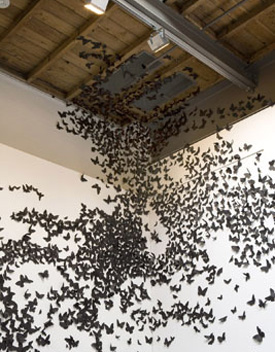
Installation art has grown depressingly popular, in part because it has grown so depressing in its subjects and in part because it has grown. Artists compete to trash the gallery while putting their egos and private lives on display. It makes for impressive performances, and it makes them stars. Excuse me while I go destroy one of Chelsea's more upscale galleries. Then try your best to excuse the gallery if it thanks me. At least try to excuse Doug Aitken.
In this bloated market, with far too much flaunting of excess, David Zwirner gallery is expanding, too—even beyond its half block in Chelsea, with room enough already for three mammoth exhibitions. Its new building a block north has five vast floors, only two for public exhibitions. So what are they doing upstairs, counting their wealth? Rediscovering the largest prime number and the Higgs boson? Plotting global domination? Hoping for a refuge against destruction?
But sometimes an artist truly responds to the site—as a part of New York, a part of the art world, and a part of the imagination as well. Already six years before, Carlos Amorales, Reynold Reynolds, and Mike Nelson all offered up dark fantasies, but they do not let one forget the real labor and real history behind them. Could Jerry Saltz be right to fear "the death of the gallery show"?
No hole in the wall
I know, you thought you had been through all this. You had seen Gordon Matta-Clark break through ceilings as Day's End and Urs Fischer burst through the floor. You had seen Sarah Sze, Grace Knowlton, and countless others turn galleries into waste bins. You had seen a critic as influential as Roberta Smith turn against the toxic combination of trashy art and costly installations—and maybe, just maybe, it had seemed time to move on. And now Doug Aitken takes a wrecking ball to Chelsea, leaving little more than a pool of water and a handful of words. The results are disturbingly familiar and chillingly effective, like an older Aitken video that unites people of the night in song.
Effective they are, though, for their scale and simplicity alone. The literal centerpiece is a huge jagged hole in the floor, as if the black stone had been crushed by a meteor. White water fills it to just beneath the surface, while more drips down from pipes suspended above. In a moment the slow drip of a torture chamber can give way to a steady rain, all under loud ambient music. The whiteness of this Sonic Fountain gives the illusion of a viscous flow. Aitken means one to marvel, but also to feel one's skin crawl.
Perhaps the meteor left the rubble by a hole in the far wall, which houses the block letters 100 YRS, covered with a photograph of children. An even more pronounced hole reveals SUNSET lit ominously from behind, with the mottled surface of volcanic rock. A third wall holds MORE, assembled from shattered mirrors. Naturally art gets the last word. Or make that ART, in the back room, its letters oozing a pale amber mud. And that is that, unless one comes back to the extend one's hand toward the holes in the walls to find no mere Sheetrock for this gallery but thick concrete.
Doug Aitken can get away with languorous overstatement—like his Sleepwalkers projected on the Museum of Modern Art. That video depended on recalling an episode in one's favorite TV program, and here the piled block letters are right out of Nancy Dwyer. Dwyer was displaying art as a LIE in Formica in the 1980s, FOOD as galvanized trash cans in the 1990s, and a literally inflated EGO in orange nylon in 2010. They are one-liners, although very good ones. If she belongs with the permanent irony of the "Pictures generation," though, Aitken reflects a less critical and more uninhibited cynicism, in the brand-name present.
Installation's excesses were always a kind of branding. They act out the anxieties of post-9/11 New York, but assuaged by the creativity of the artists—and one's awe at art. More and more, they came to announce the artist's importance and, in turn, the market's ability to assimilate the damage. With Aitken as much as anyone, one is admiring the gallery as much as the art. Who knew its weighty materials, and who can imagine the cost of rebuilding? Hurricane Sandy or Covid-19 was a piece of cake by comparison.
Note again the focus on his cred as art. The white liquid evokes oils and acrylics, and the muddy ART looks like chocolate out of Dieter Roth—just when Roth's work is inaugurating is inaugurating a still more outsize Chelsea space. Sean Kelly, too, is no hole in the wall, and its recent installations, too, were notable for their spareness and theater, but then so are fabulous squares of fluorescent color by Dan Flavin to open Zwirner's added space. Terence Koh's white casts at Kelley could have been acting out psychoanalysis or torture, Laurent Grasso's ambiguous neon spelled out Day for Night for Day for . . ., and Johan Grimonprez used the basement for a horror film with multiple Tippi Hedrens and Alfred Hitchcocks. Could Exit Art have so recently departed, in all its nonprofit grunge? Art's power may yet survive its institutions, but a meteor is unlikely to strike them dead any time soon.
Life under a cloud
Even a meteor might not restrain Carlos Amorales. He calls his installation Black Cloud, but he does not appear to live under one. Only an optimist could affix twenty-five thousand bits of paper to the gallery walls, even with the promise of caffeine and Chelsea prices. The components of his installation pretend to fly above any inundation but his own.
Their sheer number induces a lift, and so does the discovery that they have invaded the gallery rafters and even the office. I took them for butterflies and got caught up in their rising motion, with hardly a cloud in sight. Amorales uses black paper for his swarm, but it seems less an encroaching darkness than a vivid contrast with the white walls. The loud music feels at odds with so charming and fragile an installation. A darker soul will recognize the electronic buzz of a horror movie, and it stems from a video in the side gallery—a slow pan across something not unlike the installation, only sparer. The camera eye stands for a threat.
The black shapes represent something less friendly than one might expect as well—not butterflies but moths. Amorales imagines an overpowering invasion at dusk, with an interior dusty and neglected enough to hold it. Still, one has only his word for the species. One has only his word, too, for their number. The show has dark overtones, but he invites one to take his work on trust. A press release calls it "a dark fantasy tinged with optimism," and I enjoyed the paradox that a tinge, too, suggests a shade.
Interpretation does well, then, to hedge its bets. Black moths might allude to the toll of the industrial revolution, when natural selection bred insects able to hide against a soot-darkened landscape, but I doubt it. A few stray moths stick quietly to front desk. They could be smiling at one on the way out.
Reynold Reynolds tours another dark interior, this one closer to the realities of the city. A two-channel video pans and dissolves seamlessly between six cramped apartments and their equally grungy, solitary residents. They barely stir while old appliances decay, dirty dishes gather mildew, a snake slithers on the floor, a tarantula squirms in its cage, and the television flickers. Speakers closer to the viewer than to the image make the life forms that much creepier.
One starts to detect parallels between paired images, but they fade in and out of view just as creepily. A young woman's gaunt profile pairs with an older woman's ruddy face. The first's row of shoes reflects the latter's tired, swollen feet. Out front, sculpture by Wyatt Nash amounts to yet another musician turned artist trashing his apartment in public, but the video looks upon something at once more imaginative, truer to ordinary lives, and less comforting. What art or philosophy calls waiting for death, a New Yorker calls affordable housing.
Door number 3
For all the darkness, a city hides miracles. Did you know that Arshile Gorky once taught in an art school a floor above Grand Central Station? With sculpture in the parks each summer, who can say for sure where the personal ends and community begins? That is why I held out for a cultural center at Ground Zero, others hold out for the High Line, and everybody packed The Gates. Along Essex Street, the boundaries between public and private erode repeatedly, too—in the challenge of choosing the right door.
Mike Nelson takes over an abandoned food market, and half the thrill comes from discovering it is there. Much of the other half comes from opening its doors one by one, deciding when to follow others, getting lost and forging ahead to exactly where one began, and finally coming out somewhere else entirely—all of twenty yards away.
The sponsor, Creative Time, makes every visitor sign a waiver first. This one has nothing to do with the installation's dangers and everything to do with clearing access with New York City. If something below gives way, it will not stem from Nelson's quiet refurbishing. The British artist has left some matters undisturbed anyway, down to layer upon layer of dust. He calls the work A Psychic Vacuum, as he sucks out one's psyche and fills the vacuum. After the first room or two, he offers few surprises other than the location of the next door. For the most part, though, that is enough.
What he does add is ambiguity. Which of those kitchen items and which fragments of carpentry date back to a functioning market? How much of the dust did he bring himself? Nelson actually adds almost every prop, but he depends on that literalism, so that an environment can supply both comfort and displacement, a party atmosphere and an eerie silence, breadth and confinement. In England, he has restaged a hotel and turned a gallery into a coral reef—and here again the environments are in fact almost entirely of his own making. As a coral reef suggests, too, he likes endangered species, and the Lower East Side these days has more than its share.
When Michael Elmgreen and Ingar Dragset turned the basement of a nonprofit into a subway End Station, they mimed real urban infrastructure and real memories of the 1980s. When Christian Holstad turned a midtown deli into a gay meat market, he shoved the darkness and sharp edges right in one's face. Nelson does not push anything too hard, least of all a site's history. I imagined tunneling directly under the busy Essex Street market. It hardly matters that the market proper is rapidly gentrifying from its Hispanic vendors of not long ago or that housing projects still loom south of Delancey. Mostly, one thinks instead of the galleries and restaurants coming and going all around.
Men get to pass through a door marked "Women" along the way, and who knows what lies waiting behind door number 3? Only at the very end, though, does Nelson find wonders to equal the maze itself. As a guard asked when I most felt in a dead end, had I seen the sand yet? The last and largest room has piles of it, rising toward the far wall and ceiling. Its cleanness in one's hand feels like a recovery after all the dust, just as the light from the windows reflecting across it signals that one has recovered the street. After that, only the Lower East Side keeps one guessing how things will shake out.
A postscript: Little over two years later, Nelson rams together four beat-up trailers into the world's most compact trailer park. The maze offers plenty of dust but few signs of history. Quiver of Arrows also resembles his makeover of the Essex Street Market's abandoned neighbor, but on the cheap. This time, he appears to like the thought of ashes to ashes, dust to dust, only because he hates housecleaning. Also recently, Justin Lowe and Jonah Freeman have sent visitors crawling through a gallery's hidden depths. Like Nelson before, they turn the Lower East Side's oppressive history into a mind game.
Why attempt a petty reenactment in Chelsea? Um, it worked well the first time, right? Mostly, it serves as a case study in how an upscale gallery can leach art of its meaning, not to mention humanity. It is a case study as well in the pressures on a successful male artist. Build large and build again. Play hard, and do not feel obliged to sweep up after yourself. Along with the buses by Sterling Ruby parked only a block away, they pave paradise and put up a gallery district.

Doug Aitken ran at 303 Gallery through April 6, 2013, Dan Flavin and Donald Judd at David Zwirner through March 16, Nancy Dwyer at the Emily Fisher Landau Center through April 17, Dieter Roth at Hauser & Wirth through April 13, and three installations at Sean Kelly through February 9. Carlos Amorales ran at Yvon Lambert through November 26, 2007, Reynold Reynolds and Wyatt Nash at Roebling Hall through November 1, and Mike Nelson's installation sponsored by Creative Time through October 28. His "Quiver of Arrows" ran at 303 Gallery through April 10, 2010. 303 had its last show in this space, so I assume the costs involved not rebuilding but liability.