|

|

|

|

|
Experiments and Pratfalls
John Haberin New York City
Nam June Paik
For a man who invented an entire art form, Nam June Paik can easily pass instead for a lovable eccentric. His form of video art indeed plays that role with abandon. It shows off his passion for junked TV sets, maddeningly unstructured images, and seriously funny performances.
At his death in January 2006, six years after a Guggenheim retrospective, one lost a remarkable innovator and a fitting icon of the 1960s, but can one still recall his influence? One had better. One can see his mark not just in new media. One can call works of his single- or multiple-channel video, performance or Pop Art assemblage, Minimalist or excessive, installation art or just playing around. Whatever one chooses, one finds it in the madness of contemporary art as well. It can lack depth, coherence, or even feeling, but one finds that problem everywhere today, too. 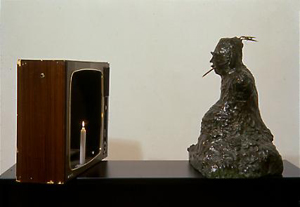
A postscript takes him to 2014 and a smaller survey. His goal was not to create high-tech toys, he long insisted, but "to humanize the technology." How then can Asia Society call its show "Becoming Robot"? The secret is to take each word seriously, the becoming along with the robot. It makes for a more interesting survey, with a focus on growth. And somehow it also makes for a more human one.
Video artist dies: details at eleven
Then again, video art alone has diverse and complex histories, while in turn art influenced TV. Video installations and single-channel video can have me wondering about a medium's split personalities. Instead of a single progenitor, one can see instead a family tree. (Michel Foucault would have said a genealogy.) And wherever one looks to locate an origin, Nam June Paik was there. He latched from the start onto a medium as elusive as a peep show and as interactive as a video game.
Way back in 1963, he created the first music video, without even a band. Exposition of Music-Electronic Television, his first solo show, filled a German gallery with doubly altered television sets. Set at almost any angle but upright, they turned a viewer's space all but upside down. And the distorted reception reflected music, performance, and still-emerging technologies. This work multiplies and displaces both the image and the viewer.
Call that video art—or art of the machine? Two years later, Paik invented it again. He bought a new invention, a Sony Portapak, just in time to catch the Pope's visit to New York. Video was born, with the new child all but blessed by the proper authorities. Now Paid could use an ordinary TV display for his art. One gets agonizingly slow-paced, personal narratives, like Andy Warhol with his innovative mix of home movies and underground film.
Born in 1936, Paik suggests video's many roots among his many friends, influences, and collaborations in the art world of the 1960s. From Fluxus, the art movement organized in 1962, Paik knew about intruding into a viewer's world. From the music of John Cage, he knew about tinkering with instruments and his environment, part of an openness to changing experience. From Minimalism, Paik takes lights and box-like objects in brazenly familiar surroundings. In a legendary critique, Michael Fried compares Minimalism to theater. What could combine the two better than television?
Paik's studies in Japan matter, too. They gave him technical skills to match his childlike fascination. He uses magnets to displace an electron beam. He piles monitors into humanoid sculpture. He guts a box's innards altogether. It all gives literal meaning to "the tube."
His career suggests a series of calculated pratfalls. One can easily miss the art behind the sense of play. If real life has now itself become a mere succession of images, perhaps only an artist so fascinated with television can embraced it. Then, too, he worked in a time when the follies of youth definitely meant an act of rebellion. Consider one last context, in the "summer of love." This video artist was always a lover.
Media junky
Remember the 1960s, before David Crosby did cut his hair and resemble an overweight little-league coach. The Latinate name Fluxus captures perfectly the fugitive moment, pretension, and self-mockery. Unlike Fluxus, however, or its exponent in Shigeko Kubota, Paik never focuses one's perceptions on oneself or the environment. He goes for sensual overload.
Does nothing last longer than Warhol's proverbial fifteen minutes? Monitors built into gardens, the fish-tank Buddha, the three-quarter moons, Paik's robots—they all flash whatever comes to his mind. It might be network programming, videos of dance, or other museum-goers. He evokes a past generation in the simplicity of his technology as well. Two sine waves add up to Lissajous figures, just as back in high-school lab. Power to the teens and the people.
Video art these days takes after the movies. Bill Viola creates romantic theater, Gary Hill writes philosophy texts, and Matthew Barney churns out epic cycles of male initiation and the great white whale. Shirin Neshat has her feminist photojournalism and coming-of-age fables. Unlike them all, Paik carried a TV around like a pet, and he treated video art as one long performance. He never stopped performing. Think of the stand-up comic who tries that much harder when the audience no longer laughs.
Unlike many in early performance art, such as Marina Abramovic or Rebecca Horn, he would not subordinate his materials to the artist's presence. Unlike Viola or Eve Sussman more recently, he had no intention of evoking the Old Masters. He did not aspire to cinematic perfection or, as with Mary Lucier, its undoing. He could not have imagined computer algorithms and data-driven landscapes. Was he then just one more part of the postmodern carnival? Maybe, but that can overlook the seriousness of the comedy.
Paik rarely lingered over the darkness he created. And yet he still has his moments of silence. In one, a lone candle burns within the shell of a television set, far from the piles of TVs used by such hyperactive artists today as Jon Kessler. The retrospective had its own moments of silence, too. And they were not all the ones he planned. The Guggenheim pushed to the top of its rotunda, but it left much of the ramp empty.
Frank Lloyd Wright exerts a nasty superiority over artists. One tends to move along the ramp, past art, as if on an assembly line. The tilt makes one see it all askew, and the upraised floors keep one from getting close enough to see it as it deserves. Empty, however, and halfway dark, it looked gorgeous. The view over a busy Central Park, itself wrapped in a late-afternoon light, was a treasure. And then there was the light of the picture tube.
Because he could not
New-media art did not simply spring from Paik's head, but it has never escaped his influence. It has acquired untold genealogies—and he had a hand in them all. One can see him as the single-channel video artist with the camcorder or the Minimalist appropriating industrial parts to transform a gallery. One can see him as the early feminist, allowing a half-naked woman to dominate on camera. One can see him, too, as the technician of off-the-shelf technology. Each gave birth to a history.
One can see him, too, in today's haphazard installations, although he sweeps away the clutter. Tim Hawkinson, for example, evokes Paik's makeshift contraptions. Now, Hawkinson flaunts his skill as a tinkerer and nostalgia for player pianos and manual typewriters. He also plays down a context in mass culture. Paik, in contrast, never lost his heightened awareness of what an era brings. Now that no one knows how to dispose of old computers without environmental catastrophe, his recyclings function as environmental art as well.
Paik worked amid an avant-garde comfortable with classical music, modern dance, small audiences, and meditation on a single candle. At the same time, he had a Pop sensibility, back when the TV had entered the living room but not the gallery. He also loved to collaborate, most notably with Charlotte Moorman on cello. He even collaborated with Amy Greenfield on a tribute to Moorman. By uncanny coincidence, the month of his death brought a show of Rauschenberg combines, starting with a stage set for Merce Cunningham. Who says the most extended artistic interchange in the wake of Black Mountain came between Robert Rauschenberg and Jasper Johns?
That same month, the Korean Cultural Service sets him alongside thirty contemporary Korean artists, although not Cindy Ji Hye Kim or the artists in "Only the Young" at the Guggenheim. "Moving Time" treats them as three successive installations. One enters the efficient chill of a midtown office building, past a visa service and steps behind a black curtain, more often than not alone. Paik's anarchy seems almost out of place but all the more pertinent.
Aside from his two works, one finds oneself amid projected images notable for their slow, patient temperament. Their skyscrapers and open country roads could supply the backdrop for late-night movies. Their main actors address the viewer or dance, but always on center screen. They could appreciate but never encompass his displacements. They lack his ability to set single-channel video apart from its monitor—or the monitor apart from what it shows.
Paik's contributions may look as tacky as an old album cover, but he made the image itself dance and speak in the present. Ironically, he made the first videos soon after his thirtieth birthday, in a decade that did not trust anyone over thirty. One can trust him that much more today. Now it often seems that everyone makes video, because anyone can. He did it then because one could not.
A postscript: video for robots
Not many can claim to have invented an art form, but Paik did that and more. The pioneering video artist collaborated with Cage, Cunningham, and Yoko Ono to push art past such tidy divisions painting, sculpture, music, dance, and performance. At Asia Society, one makes his acquaintance wheeling Robot K-456, named for a favorite Mozart concerto, along a New York sidewalk in 1964. He had arrived in the city from his native Korea via Germany just that year. And he fit right in with the idea of the avant-garde as one step above the homeless. Chris Burden could hardly have tormented himself and puzzled his neighbors much more.
Then there is the robot, starting with that first one. For all its rickety outlines, its stacks have the open architecture of a skyscraper—and nearly the aspirations of Monument to the Third International for Russian revolutionary art decades before. It is also the debris of the TV culture that Paik both celebrates and humanizes. Much of the show looks like a branch of Radio Shack back in the day, and it leads to a whole 1986 robot "family." Clunky old TV sets supply the utterly blank screen of a robot head and the bulge of a woman's hips. Other robots look like toys after all, in one case a learning toy with blocks to teach basic arithmetic. Sex and child's play were almost always on this artist's mind.
For play, Paik sat on a chair, a monitor below its almost missing seat, reaching up to the camera for a robotic self-portrait. As for sex, his collaborations with Moorman on cello run from her in a gown for Opera Sextronique to stripping for a TV Bra. The show treats her as its co-star, giving over a room to what she wore. And finally there is the becoming, starting with his own. The curator, Michelle Yun, falls short of a retrospective, like that at the Guggenheim in 2000 or the Smithsonian starting in 2013. Her brief survey has its installations and its time lines, but it really comes down to those first moments and becoming Nam June Paik.
Was Paik really becoming robot? We all have a way of becoming what we fear, and he feared civilization as an all-seeing eye, a technology, and a mere toy—even while pressing monitors, a still-new Sony Portapak, and his own playfulness into the service of art. Even when he calls a video collage Good Morning Mr. Orwell, it flashes by with the noisy enthusiasm of daytime TV. His good nature almost anticipates Jeff Koons, but with a spirit of experiment rather than pandering. It has its parallels in TV rooms back then for Robert Heinecken or a "talent show" for Andy Warhol. Paik's ambivalence is inseparable from his wonder.
When Moorman clasps portable TVs to her nipples, she humanizes them, even as they encroach on her. When Golden Buddha contemplates its image on TV, it steps outside of American culture while falling into real time. Another Buddha, in ceramic, reclines over monitors with a reclining woman. Are they two kinds of humanity or two received stereotypes from Eastern and Western art? The show's last room challenges the visitor's humanity as well. Three cameras convert one into color silhouettes.
The emphasis on performance gets in the way of a due appreciation of Paik's radicalism or even his video art. Still, he ends up looking that much more contemporary. Fears of art as a toy for the rich seem prescient indeed. His freewheeling comedy anticipates more video artists today than I can name, bred on cartoons and the Internet. They know well an endless torrent of images. Now if only they appreciated how much they were becoming robot.

Nam June Paik's retrospective ran at The Solomon R. Guggenheim Museum through April 26, 2000, "Moving Time" at the Korean Cultural Service through February 23, 2006, and "Becoming Robot" at Asia Society through January 4, 2015. I found the date of Paik's Sony Portapak in Michael Rush's New Media in Late 20th-Century Art (Thames & Hudson, 1999).