|
|
|

|

|
Playing Tag
John Haberin New York City
Barry McGee, SWOON, and Brooklyn Street Art
Can graffiti art truly have returned? I could ask Barry McGee or SWOON, but they are too busy turning galleries into the ruin of entire cities, each with its own story about art and the streets. As a postscript six years later, the Brooklyn Museum cancels its plans for a show of street art.
From the outside in
One can easily forget how little graffiti once delivered and, amid New York's dogged recovery, how pleased one felt to see it go. As a citywide, self-curated exhibition, it offered at best the shiver of recognition, a sometimes engaging simplicity, and the populist promise of taking back art and the streets. In short, it combined the guilty pleasures and mixed blessings of open-studio weekends and mass-market advertising. No wonder Keith Haring served best as a product logo, and no wonder Rheingold now uses actual graffiti-laden security gates as billboards. No wonder Jean-Michel Basquiat eagerly traded his street cred for a dealer, and no wonder, too, that the rest of the East Village art scene then cashed in and returned to Soho. 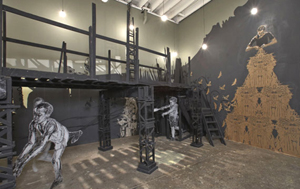
Not that graffiti ever really left. It still deposits a signature here and there before quickly vanishing again, thanks to protective surfaces and more watchful eyes. It accumulates like a poignant plea for the past within a faded institution like CBGB. Its images covers an entire building just down the street from P.S. 1, even if the action now lies within, at "Greater New York." How indeed can art escape the gallery and take to the streets again, now that outsider art refers to folk traditions as much as the outer boroughs? How can anonymous marks on the wall speak for streets that galleries and gentrification are so eager to absorb?
Ironically enough, an echo of graffiti has again invaded Soho, just when I felt certain that neither could return to fashion. When it enters Deitch Projects, however, it no longer signs its name. It has become not graffiti but street art. With proper postmodern self-reflection, that means art not just of the streets but also about the streets. Barry McGee and SWOON each take over one of the gallery's two spaces, around the corner from one another, and each makes the visitor an outsider in an unreal city. They draw one in to ferret out its design. They leave one amused or, more often, frightened and ashamed at one's glimpse of the imagined residents.
Worried about competing with Basquiat? This time out, the artists do have street cred. McGee was tagging the streets of San Francisco years ago, before heading for art school. SWOON still affixes her drawings to public places, although she has shown indoors before—logically enough, at "Greater New York." However, neither depends on spontaneous marks. Like so many these days, they are making installations characterized by deliberate confrontation and deliberate excess.
Others, too, identify a city with the proverbial handwriting on the wall, such as Gary Simmons, Gordon Matta-Clark, Rudolf Stingel, Shinique Smith, or the panoramas of an artist's book in the hands of Maddy Rosenberg. Like them, neither makes use of spray-painted scrawls except as subject or reference point. Rather than take over a city, they represent one—in a sense, not all that unlike urban realism of the past, although with a surreal twist more suited to an age of appropriation and MTV. Rather than glorify the outsider, they are more likely to reflect on the outsider that one wants to forget. If McGee looks too much an insider now himself, especially when posed next to Jeffrey Deitch, that comes with the stress on pleasure and detachment in art these days.
A previous generation took urban decay and made it a matter of pride and self-identity. That accounts for the work's edge, but also its manipulative glibness. McGee revels in ruin of his own making, like car crashes in an action film. That accounts for his immediacy, not to mention sense of humor, but also his trouble getting past light entertainment. SWOON finds moments of fear and beauty in a city whose ruin is already a memory. That accounts for her ability to evoke the joy of unregulated corners, but also their transience and risks.
The urban kaleidoscope
Neither artist follows the figurative style of graffiti art, with its bright, flat colors, heavy outlines, and larger-than-life scale. McGee, for starters, has little figuration at all, beyond a pile of small, framed cartoon faces. Rather than an ideal community, they amount to a bunch of scowls, nasty grins, and grimaces. Neither, too, has much room for words, beyond McGee's lone spray-painted phrase, Smash the State—set, with obvious irony, beside the gallery's locked front door. A metal sign, like those on the sides of buildings, begs one not to tag his installation, while three-dimensional figures are perpetually in the process of doing just that. Naturally, however, nothing ever changes.
Who needs drawing anyway, McGee might say, when he can draw one's eye in all directions. Who needs change, when one can hardly figure out what is going on? Who needs that door to Deitch's larger space, when a garage-like shed, open to Wooster Street, beckons with a welcome blast of air-conditioning? One had better enjoy it, too, because it is the last welcome one will get from his exhibition.
One emerges, to one's surprise, from the van of an overturned truck, and right in front lies quite a pile-up of minivans and SUVs. A vehicle remains sufficiently upright, far more welcoming than the pristine units of Andrea Zittel, that I could not help taking a seat, while another hides an entire dysfunctional public bathroom. The slim male mannequin by the rightmost sink looks way cooler than I as he leans over to aim his spray can at the mirror, his arm sweeping from side to side. I hardly knew whether to try to wash my hands, look the other way, or flee. He is only one in the menagerie of brass monkeys and eerily plausible men—five of them stacked upon one another's shoulders to reach higher, sharing the public space and pretending to spray-paint. And just whose legs are those wiggling suggestively through the mezzanine railing?
Clearly one has a hard time sorting out others like oneself, whatever that means, from the illusion. As with the cars and trucks, one also trouble seeing which end is up. A chaotic wall pattern, based on the old tiling of cubes in ambiguous perspective, further intensifies the disorientation. It amounts to one more element in the installation's overkill. Perhaps it alludes jokingly to graffiti's antithesis, in geometric abstraction. In practice, however, the dissonant colors and the blocks' skewed angles turn the gallery's white cube into a kaleidoscope chamber.
I could list McGee's remaining pieces on three gallery levels, from rusted metal plates covering the downstairs walls to old TV sets aglow with yet more of the tile pattern, pocket-sized liquor bottles, and syringes. The litany, like the rest of the wreckage, refers to the perils of street life, a culture of consumption and casually casting aside, and release from all these in what Mikhail Bakhtin, the literary critic, called the "carnival square." No doubt they also evoke existing representations, as in the endless traffic jam of Jean-Luc Godard's Weekend. And there, I think, lies a small problem: McGee hopes for everything and nothing.
He wants a substantive picture of social cost, but without a concrete social or historical context in the city as it exists now—or, as in the highway accident, in a city at all. He demands the street art of his early years and an ironic stance toward the viewer, but also that visceral thrill. I admired how long he had me searching and how many surprises he had in store, but I wondered when I would feel something deeper than a smile. I thought of the moral posturing and pantyhose in multimedia by Madonna, previously at Deitch. Yet when I was finally ready to head out, and the jokes came to an end, I cannot deny a mad rush of self-consciousness. I left thinking of the continuing displacement underlying a now healthier New York.
Slumming in a dream
SWOON, too, sets aside the style and textual basis of graffiti. She works in black and white and mostly on paper, attaching her cutouts to the wall not unlike Henri Matisse, much as she has to city streets in New York and abroad. Her drawings owe something to the harsh sensuality of German Expressionist woodcuts, something to the delicacy of Asian art, and indeed the dealer cites Indonesian shadow puppets among her influences. She uses no spray paint at all, and her installation incorporates just one word, as part of a represented scene. Her own handle serves less as a brand name and protection from the law than as a plea in a celebrity art market for anonymity and collaboration.
Again like the older artist, SWOON dismembers the white cube, packing the Grand Street space with a maze of stepladders and chambered passageways. Her drawings people the imagined slum, and hangings of more paper and plastic decorate it with cutouts. Like McGee's image of life on the edge, it adds up to a very male world. Her cast mostly runs to boys and their activity level runs high.
Unlike McGee's bright lights and big city, however, the work presses in from all sides, in near darkness, and the decorative element hints at still broader undercurrents of emotion. The boys still need their mother, and so, perhaps, does the viewer. One moves cautiously, even when one can decide on one's next step. Stairs lack a supporting rail, and the artificial balcony hardly adds a vaster perspective of the whole. Windows set in parallel black walls seemed for an instant to be moving instead of me, as if a bus has passed in the night. Presiding over all stands a further image of imagined danger, a roller coaster.
If SWOON creates a dream landscape, she lends it the very specificity that McGee avoids. Her closely spaced walls allude to a historic Asian walled city, and the balcony's precarious existence belongs to a more modern kind of maze, that of code violations. The people in her drawings have the precise, rushed motion, well-realized ethnic traits, and vivid fears of the dispossessed, and the name above the roller coaster identifies it with Coney Island's fabled Cyclone. Even the panels on one floor formed parts of actual wall furnishings. Although they once stood upright, SWOON does not imply a distortion of three-dimensional space like McGee's but a leveling: she refers, the gallery says, to the 1993 bulldozing of a Hong Kong slum.
For all the darkness, the scene does not lack for humor or empathy. I doubled back more than once to catch a path that I should have followed in the first place, grinning at how she had deceived me. I felt that I recognized the people, especially the mother's anguished care. I remembered that the Cyclone would probably have entertained my parents, and they would have found it fun. Even more, over time the tight spaces took on intimacy and even beauty. I was happy to brush against the cutouts, as if I could somehow recover their light.
I could not fully believe in her implicit, if ambivalent, nostalgia for sad lives and sad streets, any more than McGee's for the first wave of graffiti. However, she reminded me that political art can take flight when it has a fully imagined world of its own, like an anniversary show for 9/11 that omits art's explicit response. I thought of the personal, even outsider approaches in art after 9/11 and the controversy that they are bringing to the Drawing Center and Ground Zero. When I glanced again at SWOON's drawing of a subway, completed after other artists transformed a gallery into an End Station but before actual subway searches began, I wondered if I had seen the face of terror.
A postscript: out on the street
You have to hand it to the Brooklyn Museum. It has since had to cancel "Art in the Streets," an exhibition on its way from LACMA, for lack of money. According to Arnold Lehman, the museum's director (as quoted in L.A. Weekly), "With no major funding in place, we cannot move ahead." Now graffiti is once again out on the street.
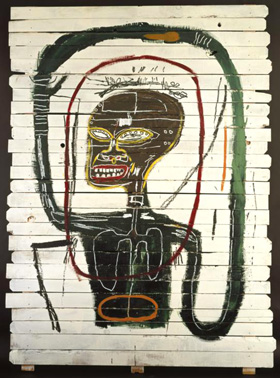 Perhaps the museum is eager to identify with starving artists, but somehow I doubt that street artists will empathize in return, no more than street art's smart simulation from Raymond Saunders. They face too many barriers, including steel fences, the law, and disdain. Besides, theirs is art on the cheap, not a cross-country fund-raiser. A shortage of funds to display them is biting irony, and the ironies keep coming. The museum's incessant pandering, in the guise of reaching out to the community, has gained it neither respect nor community. Despite evening loungers once a month in the lobby, it has flat attendance and an even flatter contribution to New York art.
The show made its share of enemies well before the June 2011 cancellation, starting in LA. As early as April, the Los Angeles Times was questioning the role of Roger Gastman—simultaneously curator and principle in the art biz, in a firm with claims all its own. "With a roster of today's hottest creatives," RRE can "legitimize your brand." Meanwhile it gets harder and harder to track where a nonprofit stops and branding begins. Jeffrey Deitch, the fashionable Soho dealer recruited to run LA MOCA, is already talking about alternative New York venues. LACMA was already peddling spray paint in the museum gift shop.
Could finances have covered for backing down to political pressure? At the very least, politics and money went hand in hand. Heather MacDonald of City Journal denounced the exhibition as "radical graffiti chic." The Daily News kept the pressure on, as did Peter Vallone, a city council member and chair of the ominous-sounding Public Safety Committee. They saw it as a blow to every merchant trying to stay alive and clean, and Los Angeles had in fact reported an uptick in illegal graffiti. Still, the critics have some branding of their own in mind, along with a loaded agenda. MacDonald represents the conservative and militantly pro-business Manhattan Institute, and Vallone represents another borough entirely, in northern Queens.
They can complain all they wish, but the show comes as less a threat than an act of desperation—and a pathetic reminder that street art lost much of its contact with the streets some time ago. SWOON and Basquiat had their turn, the latter twice over already in Brooklyn and both times well after his death. Subways have come clean, while the graffiti-covered building across from MoMA PS1 is an institution, and I do not mean a mental institution. The Brooklyn Museum is unable to build support because it is unable to reshape the arts, and it is unable to reshape the arts because it can only repeat old news. Even the sheriff of Los Angeles county sounds resigned: "It goes with the territory."
Other museums, too, are juggling commitments to the past, the public, and wealthy private collections—from the Guggenheim to Bard College and the Virginia Museum of Fine Arts to the New Museum. Yet reviving the Brooklyn Museum will take more than short-term cash, graffiti, "cartoon art," and fashion displays. As I wrote the previous August, "a museum cannot fulfill its responsibilities to the community apart from its responsibilities to art." It will take reconceiving its architecture, not as a dance floor or a detour, but a direct connection to featured local artists and to the permanent collection. When Basquiat and Andy Warhol collaborated, they shared a belief both in an elite and a factory. For all their flaws, one can learn from them.

Barry McGee and SWOON ran at Deitch Projects through August 13, 2005. The The Brooklyn Museum canceled its plans for "Art in the Streets" on June 22, 2011. A related review looks at street art in "Beyond the Streets."