|
|
|

|

|
Coffee, Paper, and Other Obsessions
John Haberin New York City
Gwyneth Leech, Noriko Ambe, and Simryn Gill
When does art become obsessive—or as addictive as caffeine? Gwyneth Leech enters her own landscapes, assembled over weeks from disposable coffee cups. And even that sounds restrained compared to a male determined to be a showman. Stephen G. Rhodes could never settle for paper cups when he can afford real coffee mugs—and afford to smash them. He hopes in the process to smash, too, a philosopher of obsessive thought and habits.
Noriko Ambe, comes closest of all to a landscape, but on the truly modest scale of books. They just happen, however, to be other artists' books, which she obsessively empties of words. 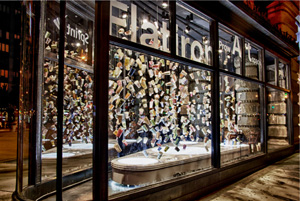
Nor is she alone in slicing books to pieces. Simryn Gill did so not so long before. Gill makes the weight of words that much more inescapable, to the point that one can hold them in one's hands. She offers a library as a point of departure, toward a distant isle and a kind of New York history. A postscript takes her up through 2012, with photographs of abandoned housing in Malaysia. In different ways, each of these shows depends on an artist's obsession.
Color as obsession
Many shows begin with a studio visit, in that moment when a dealer says, I want that in my gallery. With Gwyneth Leech, however, that was not just her work. It includes her colors, her studio detritus, her habits, her obsessions, and for that matter the artist. And in the process, all of them have changed. They have become an ever-changing landscape and an installation.
"Hypergraphia" first occupied the Fashion Center Window, around the corner from her dealer, and Leech looks even more exposed later the same year, in the windowed tip of the Flatiron Building. She sits exposed, sketching on takeout coffee cups both upscale and down, and the results are everywhere. Paper cups fill the shallow space, surely hundreds by now, hanging from the ceiling or stacked on the floor, like a caffeine fiend's replacement for the plastic-cup landscape of Tara Donovan. Still other cups sit upright, holding the tools of the artist's trade, mostly roller pens. Their lids, the kind designed for sipping, may litter the floor. Passers-by may stop in out of curiosity or simply rush by to Madison Square Park or along streets crowded with the wholesale garment business.
For Leech, as for them, one might think of this as a job or an obsession. Caffeine is of course an addiction and a staple of most workplaces, and the initial installation ran workdays rather than gallery hours. (Its reappearance in the Flatiron Building's Prow Art Space has made it a visible and active part of New York's fall and holiday seasons, much as for Xin Song or Garret Kane.) Hypergraphia is the compulsion to write, and Leech covers cups to the brim with a mix of abstraction, skyscrapers, and goodness knows what else. I think I spotted some cute squirrels, but I cannot always swear when a colorful pattern belongs simply to the found object. After all the criticism recently, trashy installations between architecture and a wrecking ball can get along quite well as a site for modest but visually compelling art.
For all that, the artist looks quite calm—patiently drawing, tuning out the male gaze or the passing scene, and in fact rarely drinking. The cups might almost have emerged out of nowhere, and the patterns of art and mathematics might have emerged of themselves. Coffee is also a diuretic, but she does not seem overly troubled by it. Besides, she could hardly get up too often without knocking something over (although friends report having missed her on, no doubt, a coffee break). Perhaps Whistler's Mother was in need of an update for twenty-first century Manhattan and twenty-first century neuroses. Naturally the reception served coffee instead of cheap white wine.
Stephen G. Rhodes has a fixation of his own on coffee—and on failures of the flesh. He just cannot decide whether to make fun of it, to identify with it, or to turn it into a spectacle. His last multimedia installation included a gallows, inspired by a short story of a condemned man's final moments, consumed by a fantasy of salvation and home. His latest centers on an early essay by Kant, a notorious late bloomer. Rhodes himself translates its conclusion in lieu of a press release, with a lack of clarity and syntax that Google Translate will not envy. In it, philosophy's great idealist traces mental illness to intestinal disturbance.
The LA artist, who called an early piece Circle of Shit, should know. His shelves hold a multitude of coffee cups (and an automatic drip machine, which I sure hope worked better at the opening), while on video a foot repeatedly crushes more. This all goes to mock Kant's habits, including a daily walk so regular that neighbors could set their clock by it, almost like real-time video by Christian Marclay. It all has something or other to do with history's neglect of Kant's servant, who would have had the discretion not to repeat that tired story. For all Rhodes's mockery, though, Kant's habits give human particulars to a thinking man's generalizations, not unlike his preposterous explanation of mental disorders. Besides, one can probably set one's clock by my workouts, too—or my blog posts.
Artists cut loose
Noriko Ambe creates a layered portrait of the artist, with a different kind of paper trail than coffee cups—in text and images that one never quite gets to see. She shapes twenty books on leading artists into quite a group show, at least (as the saying goes) on paper. For Alberto Giacometti the covers press in on a thin man out of his nightmares, fashioned from its pages. For Félix González-Torres, the pit in a volume pairs with its shreds, as a corner piece on the floor. Damien Hirst catalogs laid flat on sliding shelves become of a piece with his natural histories. A Roy Lichtenstein dot-scape and the topography of cut paper expand into a sparkling imagined city.
Obviously Ambe deconstructs the artists, just as her X-Acto blade eviscerates their work. She has appeared in shows called "Cutters" and "Mutilated/Cultivated Environments," along with such architects in words and environmental artists as Sarah Sze. Others such as Ishmael Randall Weeks in "Greater New York" have cut books into mountainous landscapes. At the 2011 art fairs, still another cut up Artforum. They lacked Ambe's quiet care and portraiture. They also had me wondering if any of those issues of Artforum covered Leech or Donovan.
Like them, no doubt, her project is something of an inside joke. She favors such ironists and insiders as Richard Prince and Andy Warhol. (I promise not to give away all the punch lines.) She even shared the Flag Art Foundation with Jennifer Dalton and Robert Lazzarini. Dalton again catalogs the limits of the art world, as she did the previous spring with William Powhida. Still, Ambe plainly believes in the visual arts.
She may be joking, but she respects her artists—or even improves on them. John Currin becomes an evanescent tribute to Renaissance beauty. Hirst's shark (or perhaps a wave of formaldehyde) escapes its tanks in a burst of color. She also gives the artist's book a double meaning: it is not just text as art, but the artist's printed text as text for art. The Japanese-born sculptor, based in New York, may not give away her magic or sit exposed, but I appreciate the reticence. Her artist's life is still an open book.
When it comes to comforts, collections, and obsessions, one will always have words—at least until books, too, become distant memories. Or at least, Ambe might add, until an artist eviscerates them. Even then, I suppose, one will have memories. My parents divorced when I was seven, and I moved, but I can still remember the name of my first public library. I guess that means I must have used it, and it was half a mile from home. Barbara Page insists on the same kind of memories.
She, too, indulges in an artist's obsessions, with perhaps a heavy dose of whimsy. Page shares her "Book Marks," on the cards that used to track loans on the inside cover of library books. She inscribes each one with the author and title from her own reading, stamps it with a year, and fills it out with a drawing. Naturally art books lead to handmade images after Frank Stella, Elizabeth Murray and Murray drawings, and Vincent van Gogh. Hemingway gets a gun, Animal Farm a pig, Tom Sawyer a paint brush, and many others a window onto natural histories. The nostalgia can get heavy, especially for the cards still resting in old wooden card catalogs, but preposterous stamped dates acknowledge the foolishness of looking back, and the images keep one looking for more.
Three little words
My first term in college, a professor introduced King Lear with just three words—nothing, nature, and sight. He asked us to follow their resonance through the play, almost like actors, as they articulated the tragedy. Perhaps we could have examined them more closely had we paused to slice out the words, sorted each into its own plastic bag, held them to the light, weighed them in our hands, and turned the pages once again to feel their absence. We could have come closer to nothing, nature, and sight, but who knows what else would remain? "Nothing will come of nothing."
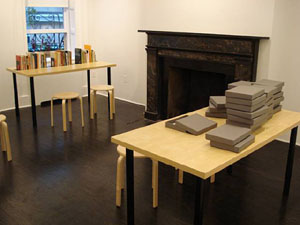 Those three words could also make a pretty good definition of conceptual art, and the process describes a project by Simryn Gill. Visitors can thumb through two tables of books, but she has already removed every instance of some eighty words, adding up to some gaping holes. No other writer has Shakespeare's expansive vocabulary, and the excision devastates more than a hundred well-worn hardcovers and paperbacks, suggested by friends of the artist as personal favorites. Voices as expansive as James Agee and Bob Dylan become close to mute. Books for hobbyists or self-help lose their meager utility. The prefaces, which Gill leaves intact, appear to chide the authors for not living up to their advance billing.
One can pull up a chair at a third table to check out the key terms in this lexicon. I expected imposing trash bags, but instead they fill to differing degrees Ziploc bags, stacked in turn in small cardboard boxes. Words like always and still sound weighty, but here they hardly seem worth the paper on which they were printed. Gill does her best to hide her conceptual traces along with the original sentences, like the plot for Matthew Brannon. The choice of words developed from her private associations, although one can never know how. I doubt that even she could explain it.
Ask artists, and they will tell you how they value the artist's book and book art as collaboration and as object that one can touch, much like these. Elsewhere in publishing today, as with Richard Benson in photography, engravings will have given way to digital prints, the production editor with an X-Acto knife to desktop publishing. In real life, too, the blocking out of words raises frightening stories of censorship and destroyed lives. Recently a man held illegally in the war on terror told of mail from his family with even the greeting blackened, probably the word Allah. If one could have shared a bag weighted down by instance after instance of that word, he would have had fitting testimony.
For all its postmodern love of text and emptying of language, then, Gill's work has an old-fashioned charm, much like the gallery's home at the time in an West Village brownstone. Yet she has created something unusual and as well as inviting. She offers the artist's book without much of its text and without the hand of the artist, and yet each morning the gallery restores the books to her precise intended order. She offers conceptual art that one can hold, at least briefly, in one's hands—conceptual art that reduces its own text to nonmeaning. Something similar happens in her photographs, in which a small, mountainous island in Indonesia has a huge back story. I found this version of the artist as traveler less successful than the literary one, but it reflects the same puzzle of judgment in light of visual, verbal, and personal evidence.
The Dutch traded another island to the English for this one, preferring nutmeg to the commercial future of New Amsterdam. The deal had ramifications in property as well and in and at least two Anglo-Dutch Wars. In fact, the artist, born in Singapore and living in Australia, would probably enjoy spelling it all out. Either way, she is framing straightforward compositions with a less visible socioeconomic narrative. Other photographers have staked high concept on taut or even banal execution, like Shelburne Thurber in therapist offices, Lockhart with her blank-faced teens, and Catherine Opie in American cities. For Gill, however, what starts out as obvious significance may end up in plastic bags for recycling—or in escape from the trap of words.
A postscript: my own private Mondrian
Gill relishes words and the gaps they leave. Yet five years later, a small town in Malaysia appears simply and beautifully, in black and white—until one starts counting the shadows. Gill takes interiors empty of everything but panes of glass and shafts of light. She nurtures the contrasts of dark, screen-like textures and firm, bright outlines, in what are in reality transparent sheets and empty space. Life goes on for all that, in trees seen through open windows and reflected off surfaces. The very decay might be returning the product of human failure to raw perception.
As usual, though, nothing is that simple. In the past, she has given her photographs a complex history, and the back story sometimes mattered more than the compositions. Indonesia, in 2007, came with a history of the Dutch colonies, exploitation, and war. For Gill, born in Singapore, Asia no doubt comes with a personal history as well, although left unstated as well as unseen. And in Malaysia, too, decay is the socioeconomic product of invisible human decisions. One would not know that the Minimalist interiors belong to Tudor-style housing from the 1980s—or that the panes lie singly or stacked against the walls because thieves took the window frames, for cash.
Signs of artifice extend to the visible as well. Sunlight's translucent volumes look at least as solid as the crumbling architecture and its debris on the floor. The rectilinear slices of nature look like pictures, pasted on the prints or hung on the wall. Every so often, a corner of glass protrudes into a window, as an additional layer of geometry. The series title, "My Own Private Angkor," further asserts and confuses its history. Look all you want for a temple or the Khmer empire, but mostly Piet Mondrian would be pleased. 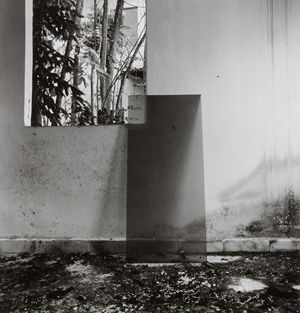
The outsize display makes the artist's effort all the more obvious, in two tight rows along four walls, all from 2007 to 2009. Step back, and they look more uniform as well as more massive—just one black rectangle after another. Even the framing runs closer to Donald Judd than to Mondrian. Gill typically places one, two, or three glass verticals at the center, and the composition then takes care of itself as best it can. One could dismiss the whole idea of beauty in decay, as with Andrew Moore, as "disaster chic" (although Moore himself went on to pursue his dreams in the Hudson River Valley) For all that, though, the ninety images draw one close to appreciate the paradoxes and the light.
Gill must relish the irony along with the majesty of Angkor, the world heritage site in Cambodia, and she has a habit of emptying out text while adding words. I am not sure which was more at stake in her past photographs, but another 2007 project sliced words out of actual books. Friends recommended the library, but the artist's predetermined vocabulary landed in Ziploc bags, from an effort at least as obsessive as the fixation on housing in Malaysia. Now she goes easier on the words, but their absence speaks to their power. Gill and the viewer enter along with the sunlight, only to find empty windows. Her process of accumulation runs in parallel with looting, loss, and entropy.
Gill shares the gallery with another bit of prepackaged but enforced disaster. Nicole Cherubini uses found cardboard as molds for prefabricated clay. Her "nonfunctional boxes" may receive further architectural support, in the makeshift pedestals on the floor or holding them to the wall. Still, she clearly delights in crushing things and then cheering them up. The gallery compares her to Eva Hesse, but the finished products run to glazing, bright colors, and the outlines of traditional pottery, if a little misshapen. Still, they have a ways to go before their construction and destruction match Gill's Malaysia.
Gwyneth Leech had pop-up shows at 215 West 38th Street through April 1, 2011, and in the Flatiron Building extended through February 18, 2012, organized by Cheryl McGinnis. Stephen G. Rhodes ran at Metro Pictures through March 5, 2011, Barbara Page at the Center for Book Arts through June 25. Noriko Ambe ran at the Flag Art Foundation through September 10, 2010, Simryn Gill at Tracy Williams, Ltd., through January 6, 2007, and through August 17, 2012.