|

|

|

|

|
Land's End
John Haberin New York City
Dietmar Busse and Roger Ricco
Sharon Lockhart and Mutilated/Cultivated Environments
Summer always has me missing the outdoors, and art has long promised a window onto nature. As summer 2006 began, however, three shows had me picturing fallen leaves and wondering where the real landscape begins.
Dietmar Busse and Roger Ricco both use photography—to many viewers, a medium as flat and direct as the land. In "Mutilated/Cultivated Environments," a group show of artist books, one can hold a semblance of New York in one's hands like a book. Sharon Lockhart even calls her photographs "Pine Flat," as if to insist on a prickly, unretouched image of America. However, each describes a landscape shaped by human presences and absences, whether of staged sets, the literature of fantasy, adolescent mythmaking, or adult mapmaking. As so often in art, mutilation and cultivation may well go hand in hand. Then again, a flat earth amounts to an illusion, too. 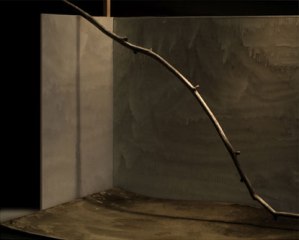
In a postscript, I bring reports of Lockhart up to date. At the close of 2009, she takes her vision of plain earth and plain people indoors. Even time seems to slow to the expanse of a flat, open prairie. However, she also insists on the video's long depth of field, the narrow opportunities offered to working men, and the temporal constraint of a lunch break. It may be the ultimate in environmental art.
Hazy shades of winter
I had to think, even if just for a moment, where the photographs of Dietmar Busse ended and where those of Roger Ricco began. I knew that one shot in northern Germany, the other on a tabletop. I knew that both rely on a medium that purportedly accepts direct impressions from nature. How strange, then, that photographs by the first could pass for a fantasy, the second for the earth in winter.
Perhaps I simply had to get past Busse's leaping horse. Its silvery motion and the frame, which isolates its head and forelegs, make it seem to have sprung to life from a long-cherished children's book. Ricco's own long exposure—of a small animal skull, like a pendulum in motion—looks much more at home in a rural landscape. Perhaps I had to stop thinking of Ricco's mold or dust bunnies as swirling snow. His restricted means, illuminated by a single light bulb, also have much in common with winter, when life slows to a halt and the meager sunlight descends from a harsh angle. In his settings, with no obvious mark of scale, a twig could reach higher than a tree.
For Busse, a thin coat of snow may have fallen half as freshly as dust, but it textures the unyielding winter soil. It picks out a road seen in perspective, like the unyielding trapezoid of Minimalist sculpture yet unknown. Photos of trees with and without snow, paired at opposite ends of a wall, resemble the arbitrary permutations of conceptual art. Busse does well to shy away from obvious metaphor, except for that horse. He seems content to work from the materials that nature puts at hand, not spinning out winter narratives of childhood lost.
That literal-minded spirit unites the two photographers quite as much as their subject matter. Ricco began his series in another kind of exile—laid up indoors, remote from the city, recovering from a motorcycle accident, but without help from Bob Dylan and the Band. The spare stage sets available to him and Busse's spare winter fields help account for the similarly narrow range of color in both. Both must have appreciated returning to New York in spring.
Ricco could easily have hammed it up, too, more than even the skulls of rural ecosystems demand. A bare bulb sounds much Billy Wilder's formula for film noir. However, he prefers to explore his means, to bring out the texture of shadow rather than its starkness. He has the greater concern for illusion, but he has fewer big stories to tell than Busse—and less obvious concern for their ending. He avoids symmetry in his props or backdrops, to the point that the ordinary shape of a table never shows. Busse, in contrast, likes frontal compositions and the pressure of a tree or road against the picture plane.
Their shared exhibition did not intermingle the two artists, but it did not keep them on facing walls either. To keep them apart, I had to look twice. Art is supposed to make me do that, but it is more unusual for photography to do so, apart from digital or other trickery, and I should never mistake this for trick photography. The gallery has a fondness for displays of skill and old-fashioned beauty, as with Makoto Fujimura and Duston Spear, but I liked this pairing most for its lack of manipulation. What you see is what you get. It just may not look like winter.
Bend, spindle, or mutilate
Landscape in art has a long history—and a nasty habit of overflowing two dimensions. It has extended to Richard Long's walks across a continent, to Janet Cardiff with her new-media march through Central Park, and to such installations as Phoebe Washburn's civilizations in progress. It has led to explorations of a gallery as a mirror of urban spaces, as in reopening exhibitions at Smack Mellon and Exit Art. Even within the context of the printed page, artists like Maddy Rosenberg have unfolded entire cities. Now the Center for Book Arts extends the locus of an artist's book still further: it becomes a repository or locus of nature at large.
"Mutilated/Cultivated Environments" suggests an escape in the heart of New York, just when summer sculpture rises indoors and out. Carol Barton and the Center's Alexander Campos invite thirty artists to open a book and to see what traces of earth spill out. Some months before, Rosenberg curated a "Dialogue" between book artists from Paris and New York. This time, too, even when the artists recover a patch of green, they often invest it in the surrounding city.
André Lee, for one, imagines Conversations in the Sky, but not the sky above distant plains. An actual string bridges her silkscreen telephone poles and the pale houses below. Joyce Cutter Shaw's Sycamore Leaf Canopy offers a different kind of human shelter, created by the depth of an open book and her precise drawing. Katerina Jerinic supplies elaborate instructions for locating grass not far from the Center itself. The walk comes closer to Long's acts than to book art, and it almost reduces his sense of personal and geologic history to family fun. I am saving her grass "tattoo" decal anyway.
Tara O'Brien plants her grass seeds in soil, not unlike a sculptural ecosystem this past spring by Roxy Paine—only encased between thin sheets of Plexiglas. No doubt a book, too, may have leaves. For Mary Ellen Long, the sprouts roll up in parchment, like earth enchiladas. Other books, too, blossom as if of their own accord. Stephanie Brody-Lederman turns her pages into Summer Roads. Kumi Korf unfolds a landscape of imaged clouds held down by real stones.
Artists in other media have been turning from depicting landscape to mapping it, as with digital records of the earth's motions. Anne Gilman's map on Mylar shows a world splitting apart at the seams, like a lesson in continental drift. However, Gilman—like Korf, also in "Dialogue"—has in mind political forces rather than plate tectonics. With a still larger map, Can We Acknowledge?, Janet Goldner raises a leading question indeed, about the havoc wreaked by America on the world, and text woven from strands of dark steel takes great pains to spell it out. Fortunately, the steel sculpture, pierced by air and peopled by silhouettes, speaks just fine for itself. Doug Beube similarly unzips the United States for his Border Crossing, mining the resemblance between old leather binding and clothing.
As another approach to mapping the earth, Laurie Spitz and Amee J. Pollack cut away individual sheets to build geologic formations, in the manner of Noriko Ambe. Guy Laramée extends the practice to mold the Grand Canyon from the volumes of an encyclopedia, but words, too, may trace a visual mapping. Heidi Neilson preserves only the punctuation from other books' pages, leaving a scattering of marks against a white sky. Sam Winston treats a dictionary as found poetry, in which his letters spread and disintegrate like the seeds of future text. The show neglects many possibilities in its title, particularly how mutilation and absence enter into the interactions between people and the land and art with what it imagines. Still, enough of earth and sky fits between a book's relatively conventional covers to remind anyone of summer.
Flatland
From her exhibition's very title, Sharon Lockhart evokes a distant landscape unredeemed by hills, broad leaves, or a broader life. Yet "Pine Flat" refers to a very real place—and to a portrait of small-town America through its children. Pine Flat lies in the Sierra Nevada foothills, and one hesitates to label it firmly as rural, exurban, archetypical, or on the edge. The flatness of the title could refer equally to the town, the style of Lockhart's photographs, or the dispirit in both.
Oddly enough, she also tempts one to find it pretty. She set up her studio in a barn, and she adopts the conventions of professional portrait photography, with standing poses against an indefinite background. The white of Richard Avedon has turned an alluring black. Lockhart also spent enough time in the landscape to know the appeal of a tree in fog or a child in restless sleep, and she projects these and half a dozen other scenes in slow, near static film strips. In her stills, the children choose their own poses.
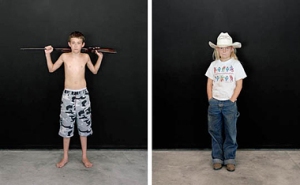 Lockhart may not give her child actors a script. Still, when the gallery boasts of her lack of sentiment, it simplifies things considerably. She accepts whatever sentimental artifice her sitters find comforting, and that means plenty.
The boy only pretends to sleep, as if restraining his impulses until his parents are no longer watching. Others push out their elbows and swagger like adult action figures. They look ready to sign up for the next preemptive war. And in a town with so few opportunities, more than a few surely will. Girls pose very much like boys, which one can take as a sign of progress—or a warning that male assumptions have silenced other voices for good.
Lockhart projects little or no formal interest, no visual or social context, and none of the shocking confrontation in Diane Arbus, Nan Goldin, or Depression-era photography. She really does mean flat. She tempts one to dismiss the work as flat, too, but does its shallowness lie in a satire of American stereotypes or an eager acceptance of them? Has she cheapened her range of feelings, or had I refused to let myself feel?
I have the same concern when, say, A Natural History of Violence or Dogville lectures me from the big screen on my corrupt nature. If I was bored, though, I may have answered way too soon. Compared to Busse and Ricco, Lockhart has the power to leave one chastened at the human presences and political coloring of what may seem a still blanker and less artful landscape. As it happens, she allowed me to recover my place in the land two years later by leaving photography and turning to New York interiors.
Give Me a Break
Lunch Break extends lunch hour to more than eighty minutes. With one long, nearly static shot, Lockhart trains her video camera on factory workers. They slump in the spaces to one side of a narrow corridor. The other side has little more than closed lockers and bare walls. The lens makes the passage seem to stretch forever. One can see its dead end all the same.
The composition might serve as a rebuke to anyone, like me, who has described Lockhart as uninterested in formal structure or social context. Not that she tidies things up. As with "Pine Flats" three years back, she likes plain, unrehearsed images of plain people. She sympathizes, but she keeps her distance. Objects and bodies fall where they may. In fact, the bodies could just as well be objects.
It takes only a few seconds to realize that the camera is moving forward. Lockhart has slowed the projection, so that it lingers over each worker in turn, and the next one seems impossibly far away. Workers do not engage the camera, and many choose to eat alone. Lunch may offer their only chance to socialize, but also their only time to themselves. Photos fill out the show, mostly in pairs. They might show a lunch pail open and closed, two views of a grimy coffee station, or workers actually hanging out together.
They also look dull as dishwater, as if needed alongside a video installation for something to sell, but something interesting lies within. Lockhart prides herself on the drab facts of life, and they cut both ways. Duane Hanson inspired the video with his hyper-real sculpture. Like him, she intends empathy but also, I fear, contributes to the image of dehumanization. Hanson's sentiment differs from the existential despair of George Segal, but he is sentimental all the same. Still, as the tracking shot continues, individuals loom into view and pass with a presence I shall not easily forget.
Then, too, at least they have a job. In fact, with such marvelous exceptions as Lisa Kirk and her pretend real-estate deals, artists thus far have had surprisingly little to say about the last year's soaring unemployment. Search the Web for "art about the recession," and you will find instead the impact of the recession on the arts. Some dream that it will help, by damping enthusiasm for the overpriced and overrated. Saner and more vulnerable voices simply wonder how they will survive. For the most part, political art still means art about 9/11, the Middle East, Katrina, torture, censorship, and war, making Lockhart's point of view that much more compelling.
Perhaps the loudest protest against Wall Street thus far comes from Hans Haacke at the X-Initiative—and with work more than thirty years old. That does not reflect badly on artists. It takes time to create and longer still to schedule shows. When Amy Wilson took her hits for her image of Abu Ghraib, the country was still in denial, but artists are always going to lean to the left. For now, the most cutting-edge image of the working class dates from 1996, when Gary Hill lined up the homeless. Meanwhile, Lockhart can serve as a slow-motion preview of art to come.

Dietmar Busse and Roger Ricco ran at Sara Tecchia through July 1, 2006, "Mutilated/Cultivated Environments" at the Center for Book Arts through September 16, and Sharon Lockhart's "Pine Flat" at Barbara Gladstone through June 24. She returned there with "Lunch Break" through January 30, 2010. A related review looks at her filmed dances and tapestries by Noa Eshkol.